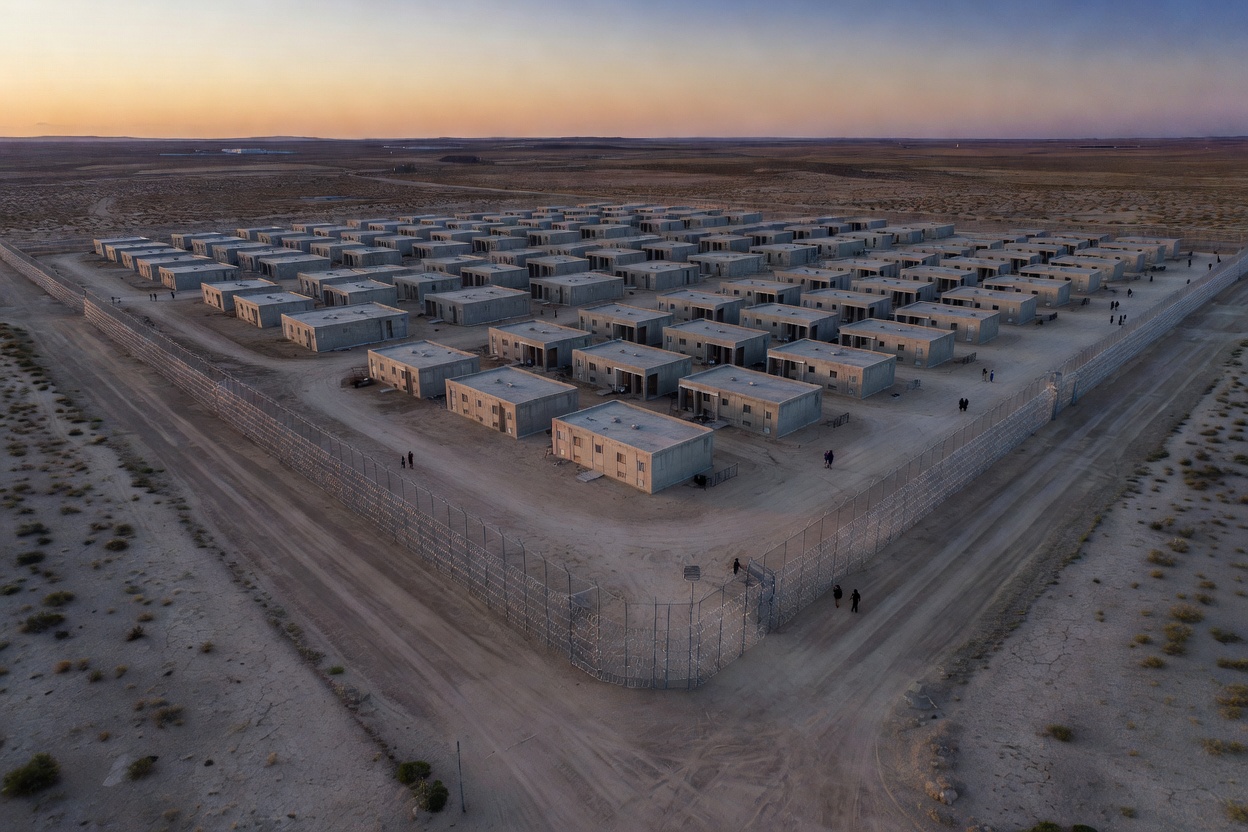
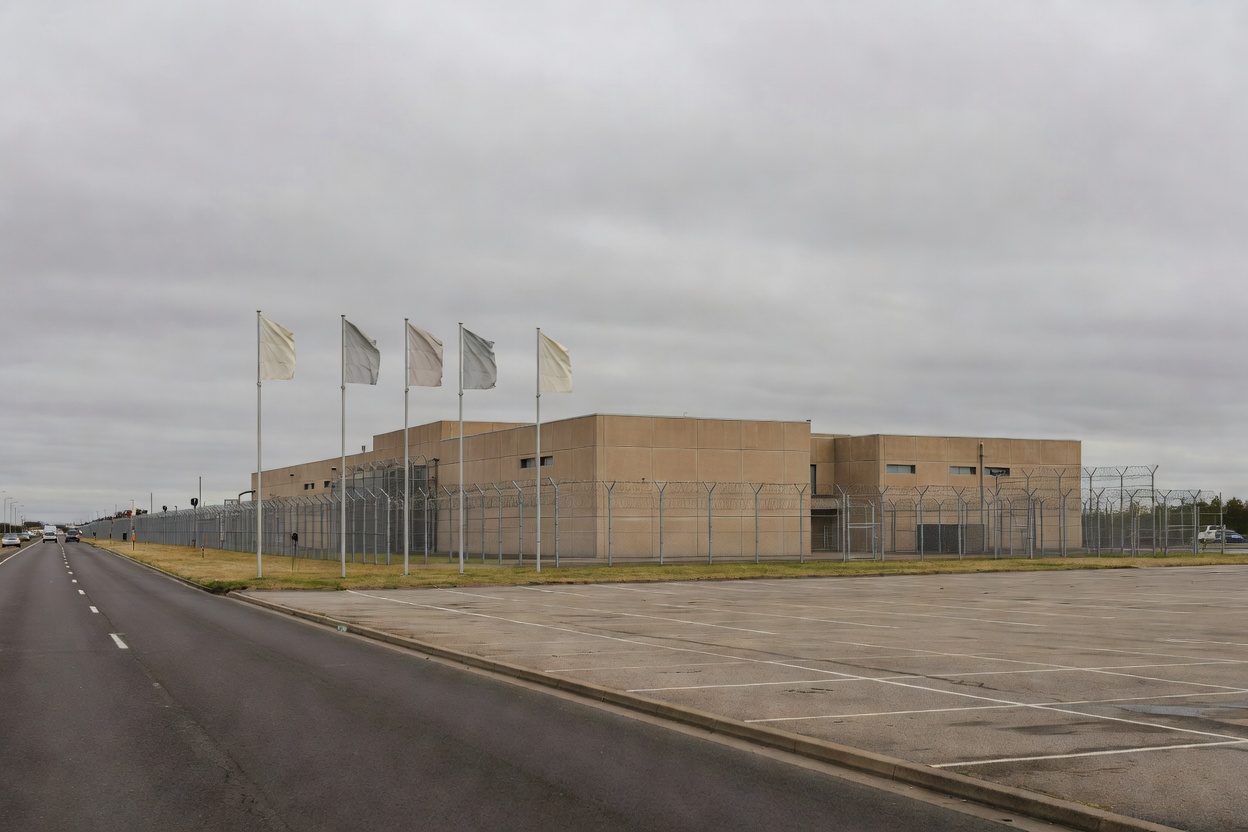
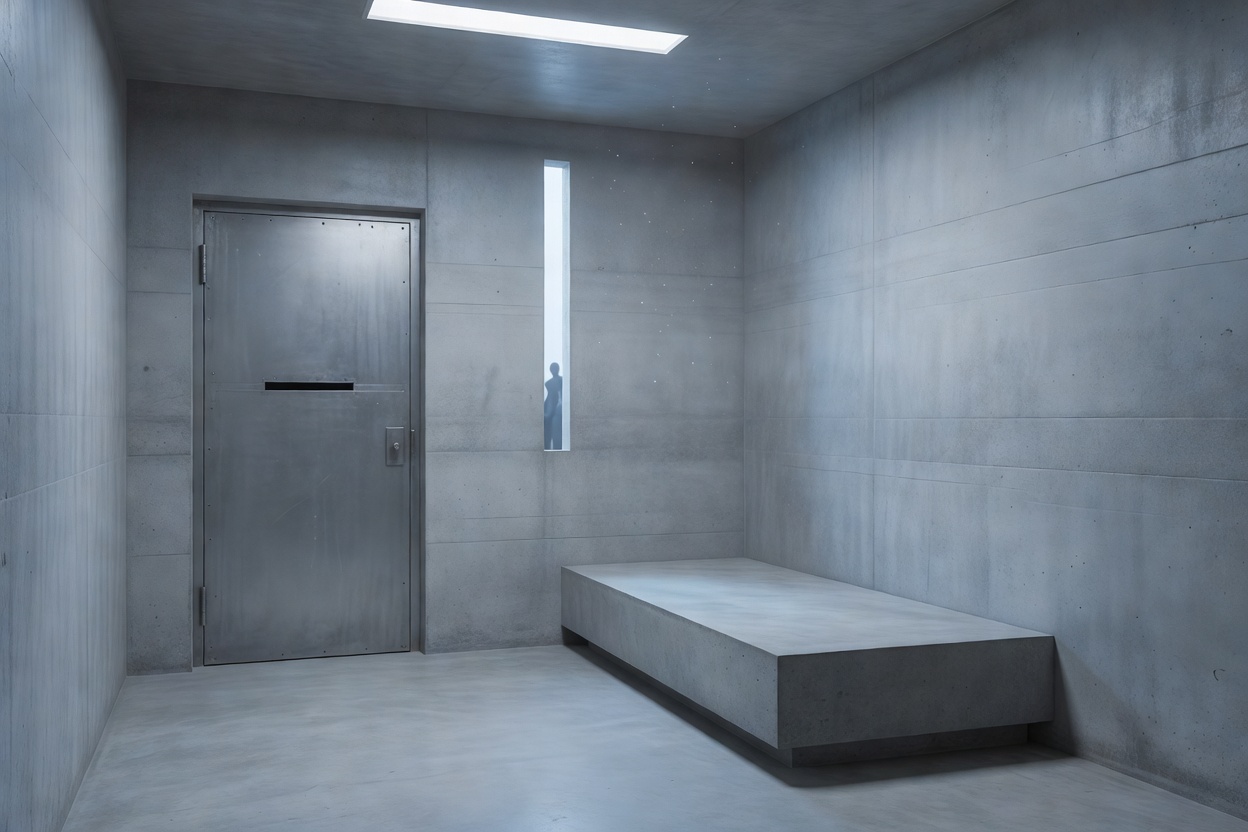
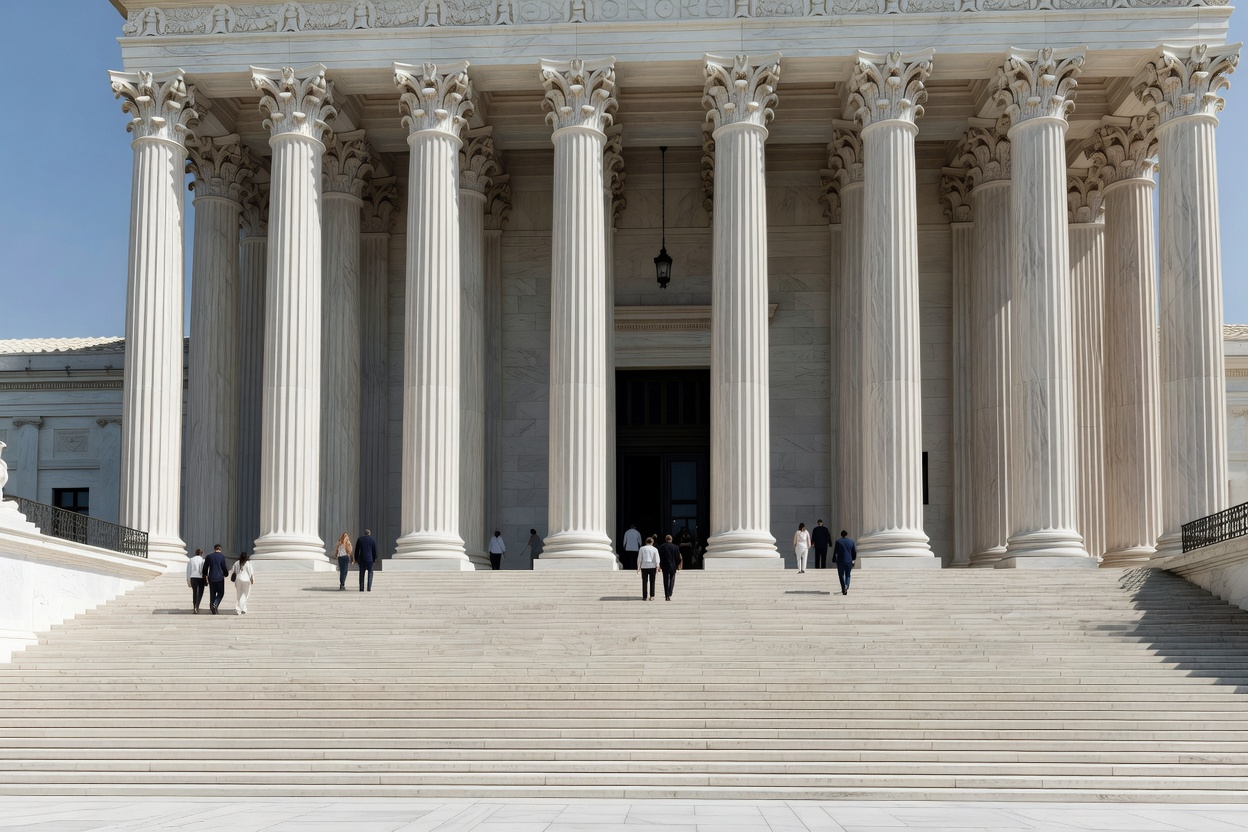
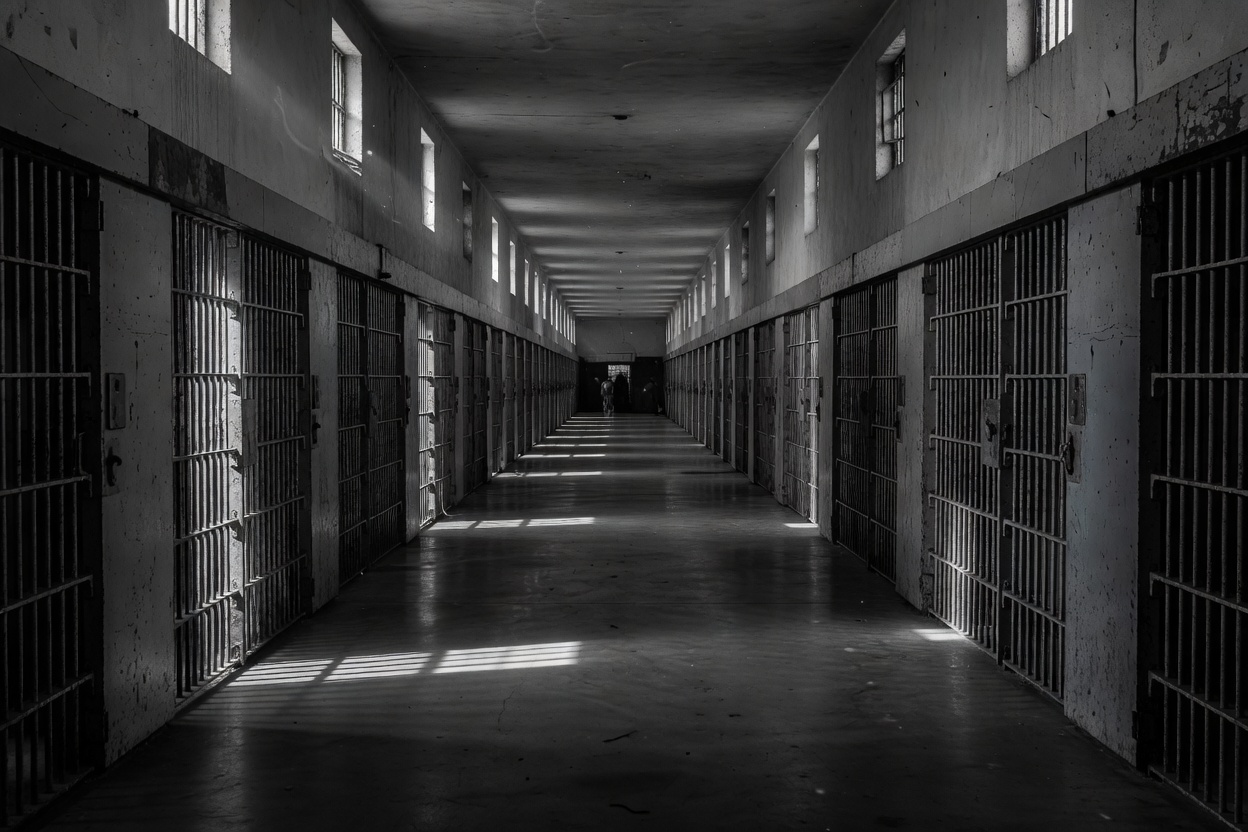
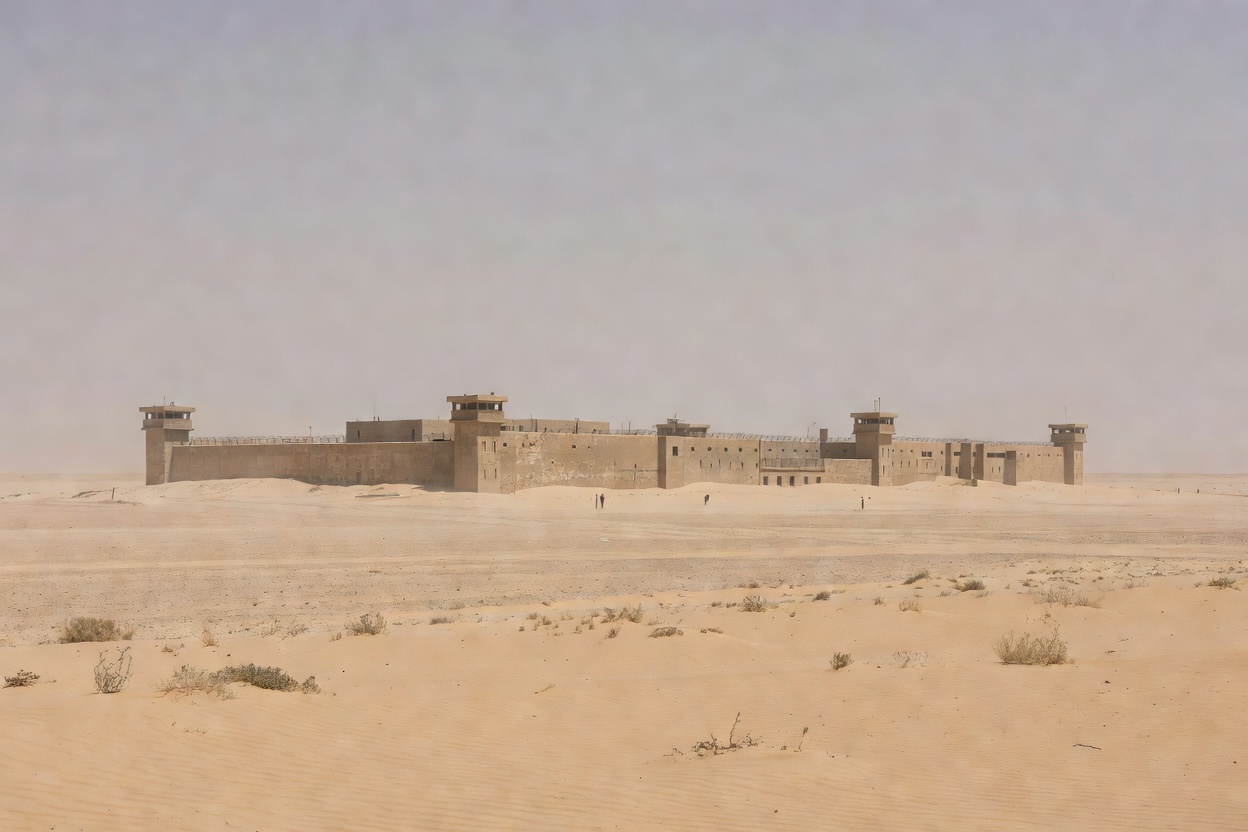
A side gallery of punishment: what societies have done to people who broke their rules, from blood-price and banishment to the penitentiary, the watched cell, the chain gang, the private prison and the death chamber, and what is being tried now. Then a map: where America keeps its prisoners, its death rows and its executions.
Urbanicity Research · Bradenton, FL · for classroom use on newSchoolWorks.com
Lessons with a gallery segment (CR1, Penology): CR1.29 The penitentiary ideaPreviewCR1.31 "Nothing works" and long sentencesPreviewCR1.32 Mass incarcerationPreview
Drawer in class: From the Pillory to the Panopticon
Quiz: "From the Pillory to the Panopticon: Gallery Quiz", ten questions, scored on submit, inside The Penitentiary Idea
Next door: Public Safety, the companion map of police, fire and emergency services · What Is Money? and its ATM-threats gallery, where the crime starts that this gallery ends · game Count the Crime
Room 1 · before the prison
The body, the purse and the road out of town
For most of history, prisons held people until punishment: trial, debt or execution. The punishment itself was paid in money, in pain in public, or in exile.
Illustration: Urbanicity house studio (SI-generated)
c. 500–1100 · Germanic and Anglo-Saxon law
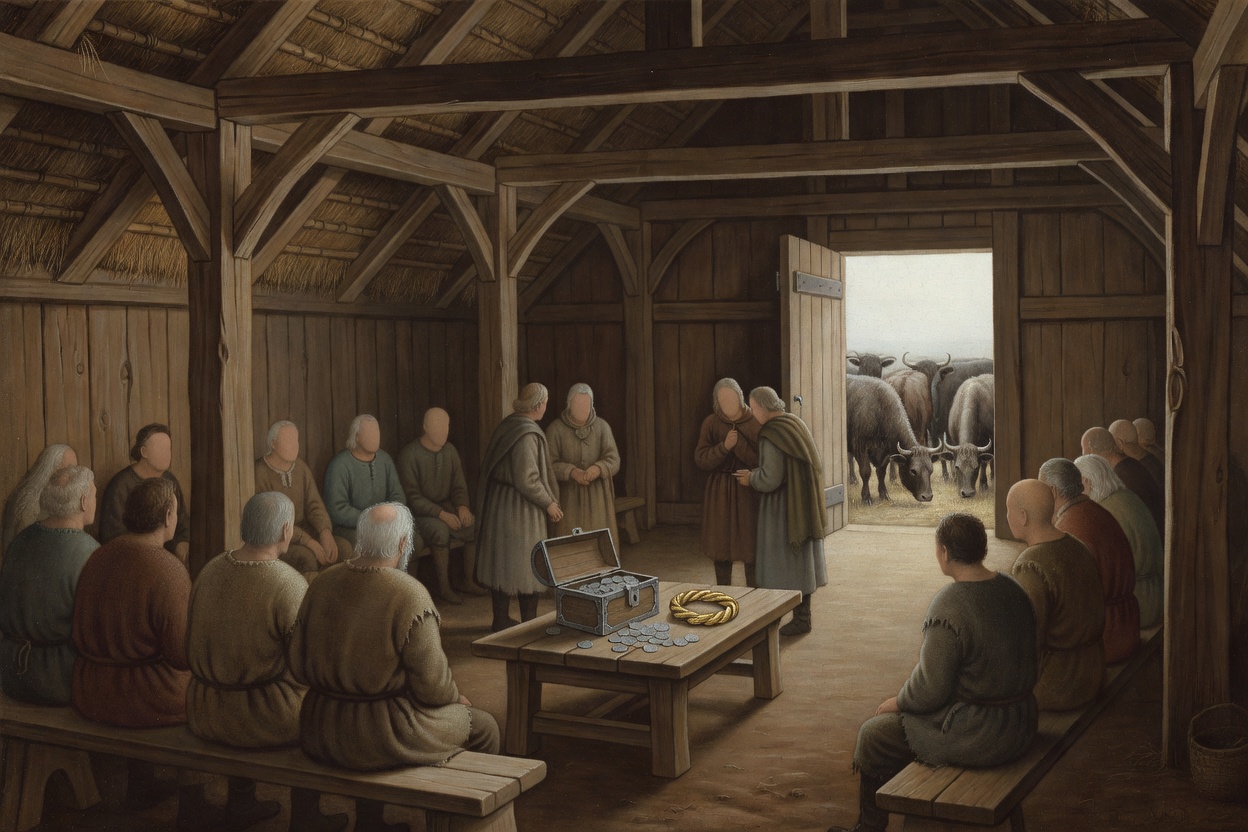
Wergild: the price of a person
Claim
Early law tried to stop blood feuds by turning harm into a debt owed to the victim's kin.
Evidence
Law codes such as Æthelberht's (Kent, c. 600) list payments by injury and by the victim's rank. The price of a lord was higher than the price of a free farmer, and an enslaved person's injury was paid to the owner.
Ask
What does a price list say about who counted most?
Is a fine today a modern wergild? What changed: who gets paid?
Source: Æthelberht's laws, trans. Lisi Oliver, The Beginnings of English Law (Toronto, 2002).
Illustration: Urbanicity house studio (SI-generated)
c. 800–1215 · Europe
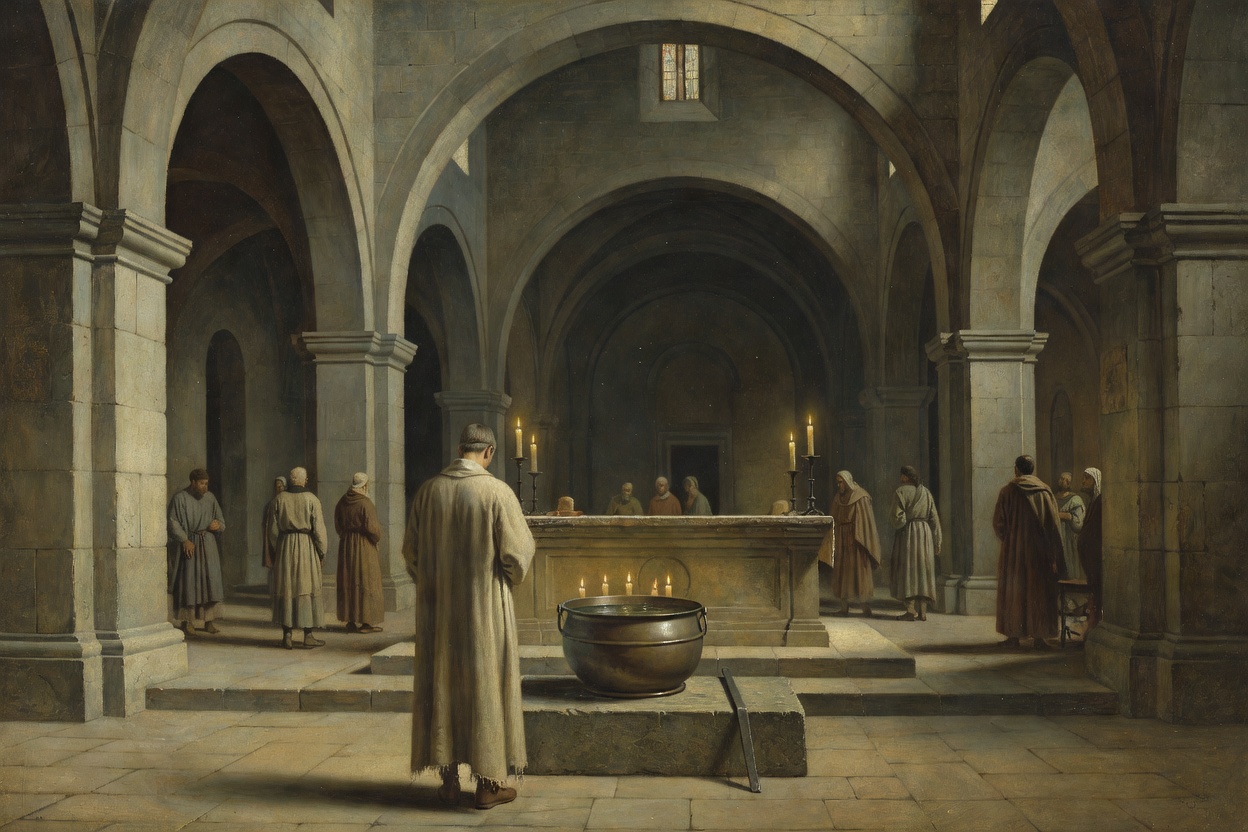
The ordeal: let God decide
Claim
When there were no witnesses, courts asked heaven for the answer: carry hot iron, or be lowered into cold water, and see.
Evidence
The ordeal needed a priest to bless it. In 1215 the Fourth Lateran Council forbade clergy to take part, and the practice faded. England turned to the jury.
Ask
Why might people who believed in the ordeal still confess before it?
What replaced divine proof, and what does a jury rely on instead?
Go deeper
Lessons:SO1.15 Deviance and social controlPreviewCR1.29 The penitentiary ideaPreview
Source: Robert Bartlett, Trial by Fire and Water (Oxford, 1986).
Illustration: Urbanicity house studio (SI-generated)
1300s–1837 · England and colonies
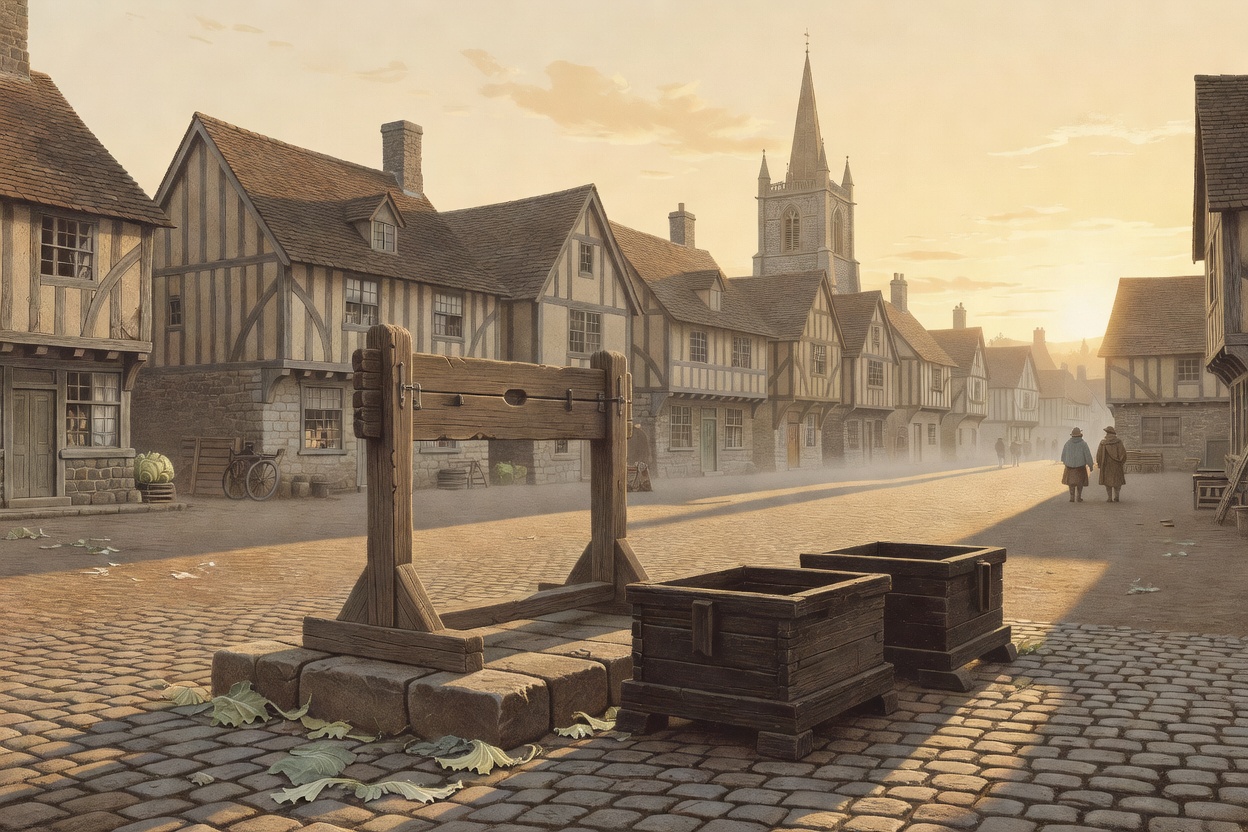
Stocks, pillory, brand and lash
Claim
Shame was the sentence. The crowd did the work, and the town watched the lesson.
Evidence
The pillory held head and hands in a board in the market square; the crowd could pelt the prisoner. Branding marked repeat offenders. England abolished the pillory in 1837. Flogging lasted much longer in navies, colonies and some US states.
Ask
What does a public punishment need that a private one does not?
Is posting a mugshot online a kind of pillory?
Go deeper
Lessons:CR1.29 The penitentiary ideaPreviewSO1.15 Deviance and social controlPreview
Source: J. M. Beattie, Crime and the Courts in England, 1660–1800 (Princeton, 1986).
Illustration: Urbanicity house studio (SI-generated)
To 1868 in England · spectacle
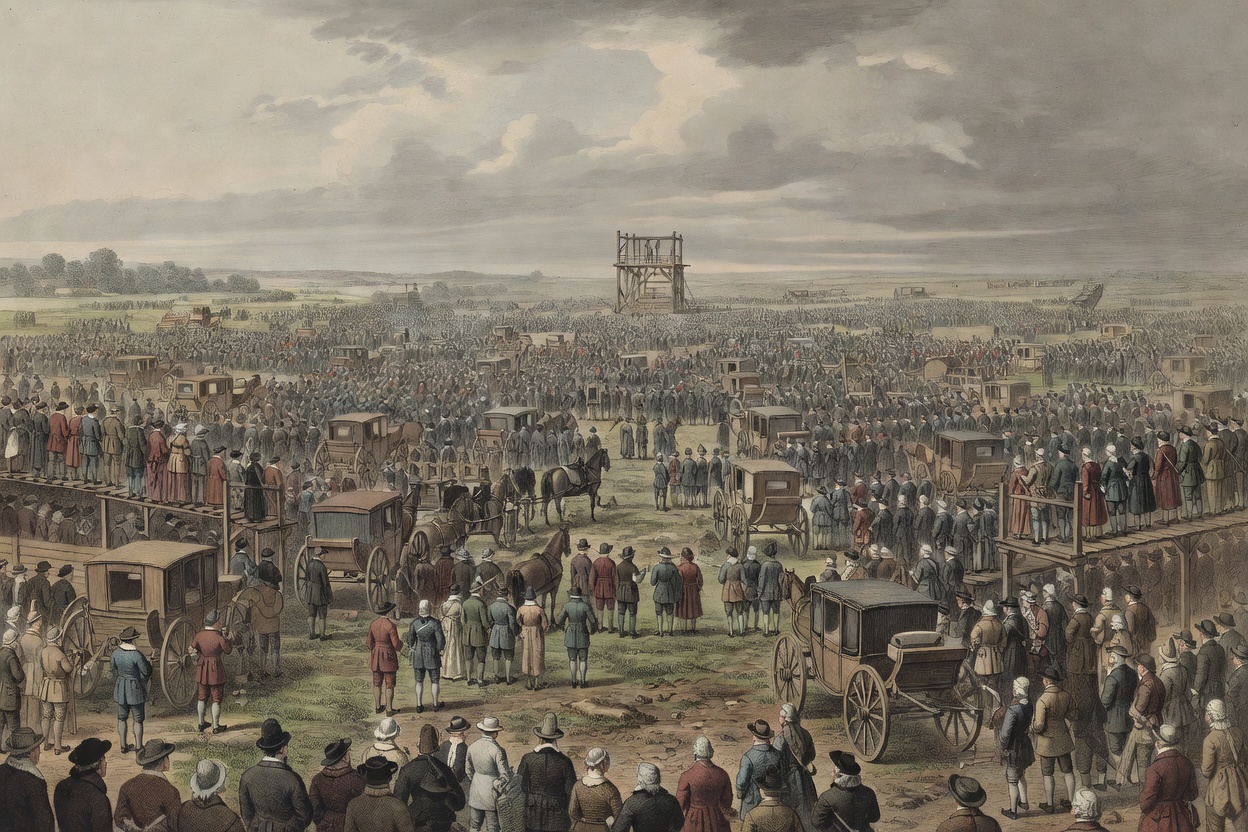
The scaffold as theater
Claim
A public execution was meant to show the power of the king over the body of the condemned.
Evidence
Crowds of thousands came to Tyburn in London. Officials worried the crowd sided with the condemned, and Britain ended public hanging in 1868. Foucault opens Discipline and Punish with a 1757 execution in Paris, then a prison timetable from 1838, eighty years apart.
Ask
Why would rulers stop staging the very show meant to frighten people?
What replaced the crowd as the audience of punishment?
Go deeper
Lessons:CR1.29 The penitentiary ideaPreviewAPEURO.5 The Enlightenment benchPreview
Sources: V. A. C. Gatrell, The Hanging Tree (Oxford, 1994); Michel Foucault, Discipline and Punish (1975; trans. 1977).
Illustration: Urbanicity house studio (SI-generated)
Medieval to modern · Europe
Outlawry and exile
Claim
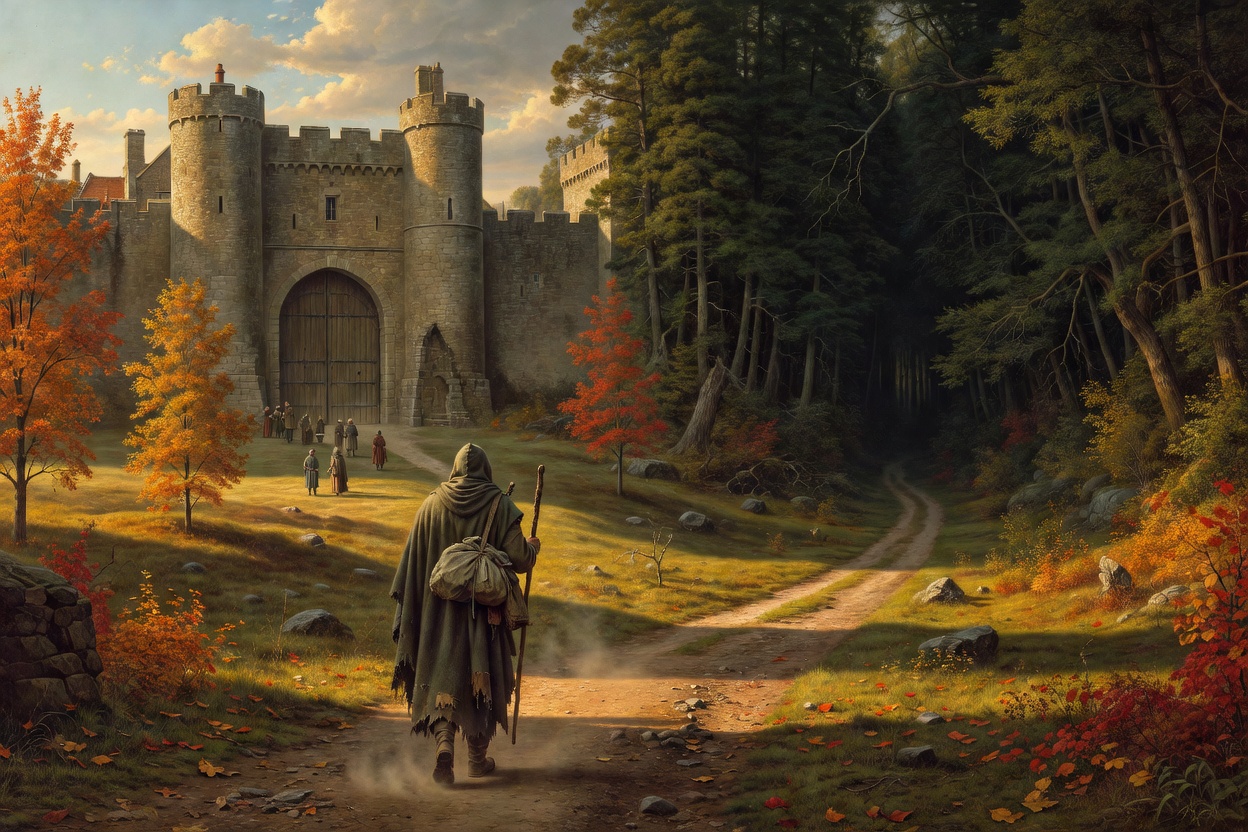
The oldest punishment may be to put someone outside the protection of the group.
Evidence
A medieval English outlaw lost the law's protection: his goods were forfeit, and he could be killed without penalty. Athens could vote to exile a citizen for ten years by ostracism. Exile, internal and external, remained a tool of states into the 20th century.
Ask
Durkheim said punishment marks the boundary of the group. How does exile draw that line?
What modern sentences cut a person off from the community without walls?
Source: Émile Durkheim, The Division of Labor in Society (1893), ch. 2.
Illustration: Urbanicity house studio (SI-generated)
1615–1953 · empires
Transportation: Botany Bay, Siberia, Devil's Island
Claim
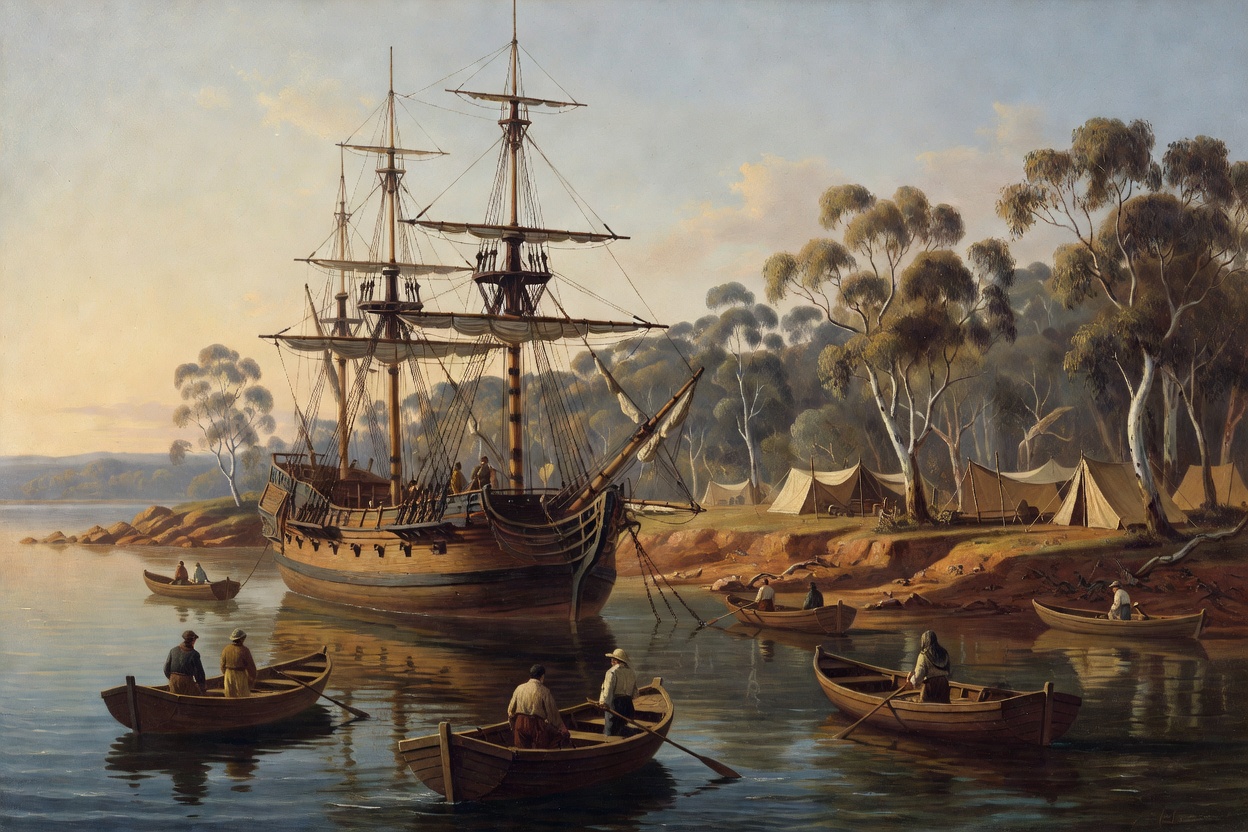
Empires solved crowded jails by shipping prisoners to the edge of the map, and built colonies with their labor.
Evidence
Britain sent convicts to Maryland and Virginia until the American Revolution closed that door, then about 162,000 to Australia between 1788 and 1868. Russia sent prisoners to forced-labor katorga in Siberia. France sent convicts to French Guiana, including the Devil's Island camps, from 1852 until they closed in 1953. Georgia (1732) is often remembered as a colony for debtors, but few debtors were ever sent there.
Ask
Who gained from transportation: the prisoner, the empire, or the colony?
Australia's convicts built a nation. Does that change how we judge the punishment?
Go deeper
Lessons:APWH.10 The Atlantic systemPreviewCR1.29 The penitentiary ideaPreview
Sources: Robert Hughes, The Fatal Shore (1986); Roger Ekirch, Bound for America (1987); State Library of New South Wales, convict records.
Illustration: Urbanicity house studio (SI-generated)
c. 1660–1815 · the Atlantic world
The age of impressment: the press gang
Claim
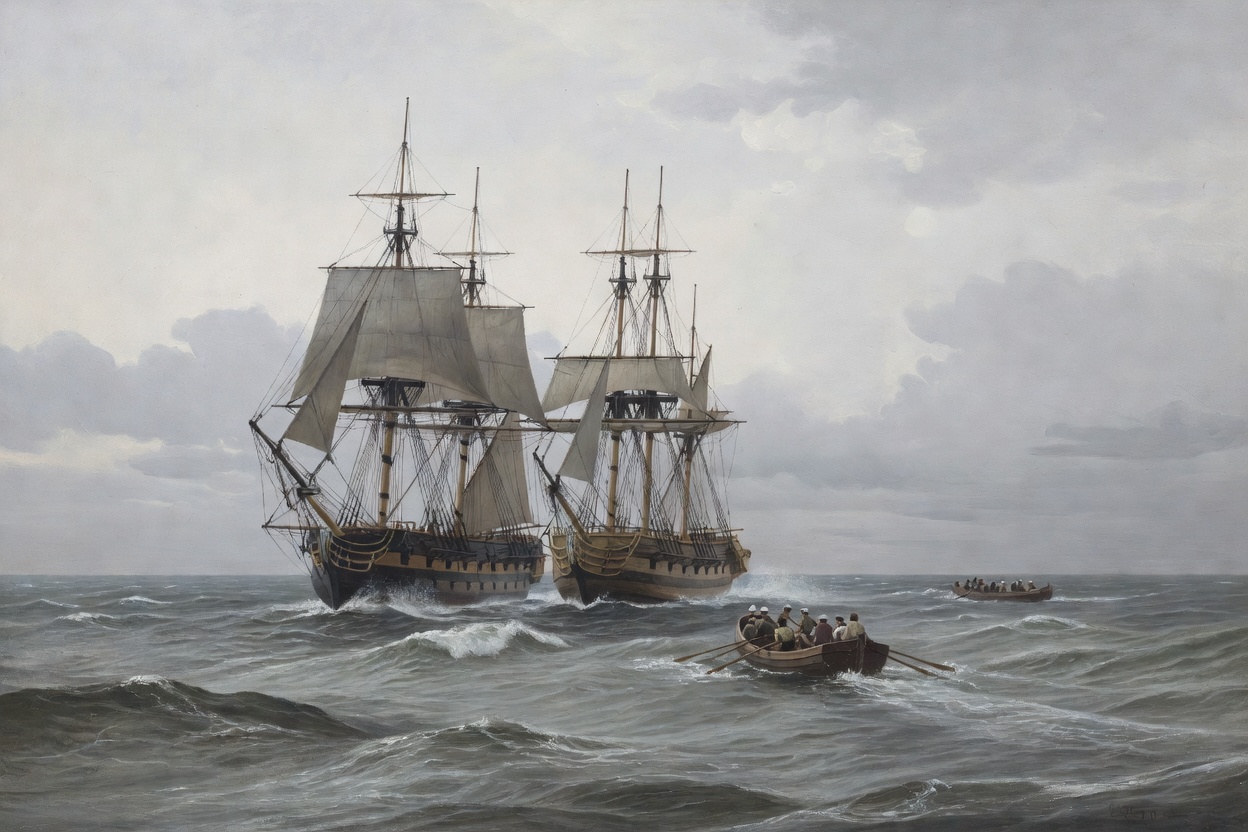
For a century and a half, Britain filled its warships partly by force. The press gang turned seafaring men, and sometimes vagrants and petty offenders, into sailors without their consent, and the line between punishment and service blurred.
Evidence
English law let the Crown "press" men who earned their living on the water, and the Navy's Impress Service sent gangs through port towns and boarded merchant ships at sea. In the long wars with France, magistrates and county quota laws (1795) also pushed debtors, vagrants and minor offenders into the fleet, so service at sea sometimes stood in for a sentence. British ships took thousands of sailors off American vessels; estimates for 1793–1812 run from about 6,000 to 10,000. The attack on the USS Chesapeake by HMS Leopard in 1807 made "free trade and sailors' rights" a slogan, and impressment became one of the causes of the War of 1812. The practice faded after 1815, and from 1853 the Navy relied on continuous-service volunteers. In American ports, "crimps" kept shanghaiing drunk or drugged men onto ships into the early 1900s, until the Seamen's Act of 1915 curbed it.
Ask
Was impressment a punishment, a tax paid in bodies, or a draft? Make the case for one.
Why did taking sailors from American ships matter so much to a young country trying to prove it was independent?
Compare the press gang with transportation: both moved unwanted people to where the state needed labor. Who decided who was "unwanted"?
Go deeper
Lessons:APWH.10 The Atlantic systemPreviewAPWH.12 Revolutions in an Atlantic mirrorPreview
Sources: Denver Brunsman, The Evil Necessity: British Naval Impressment in the Eighteenth-Century Atlantic World (2013); N. A. M. Rodger, The Wooden World (1986); Paul A. Gilje, Free Trade and Sailors' Rights in the War of 1812 (2013). See also the Museum of Atlantic Piracy on newSchoolWorks.com.
Room 2 · the birth of the prison
The penitentiary and the watched cell
Illustration: Urbanicity house studio (SI-generated)
1764 · Milan
Beccaria: certain, swift, proportionate
Claim
Punishment should prevent crime, not take revenge, and it works by being certain more than by being cruel.
Evidence
Cesare Beccaria's On Crimes and Punishments (1764) attacked torture and the death penalty and argued for laws that are public, clear and proportionate. Jefferson and Adams read it. Modern deterrence research still finds that the certainty of being caught matters more than the length of a sentence.
Ask
Why would certainty deter more than severity?
Find one modern law that Beccaria would criticize. Start with these, read on Justia and Cornell's Legal Information Institute, and say which of his principles each one tests: certainty, proportion, or no death penalty.
Three strikes:Ewing v. California (2003), 25 years to life for stealing three golf clubs, upheld. Proportion?
Life for a first drug offense:Harmelin v. Michigan (1991), mandatory life without parole for 672 grams of cocaine, upheld. Compare Solem v. Helm (1983), where a life sentence for a bad check was struck down.
Mandatory minimums by drug weight:21 U.S. Code § 841(b). Does the sentence fit the person or the scale?
The federal death penalty:18 U.S. Code § 3591. Beccaria argued against it outright.
Florida's death-sentence vote:Florida Statutes § 921.141, changed in 2023 so 8 of 12 jurors can recommend death.
Go deeper
Lessons:APEURO.5 The Enlightenment benchPreviewCR1.29 The penitentiary ideaPreview
Sources: Beccaria, On Crimes and Punishments (1764); National Institute of Justice, "Five Things About Deterrence" (2016).
Illustration: Urbanicity house studio (SI-generated)
1787–1791 · England
Bentham's panopticon
Claim
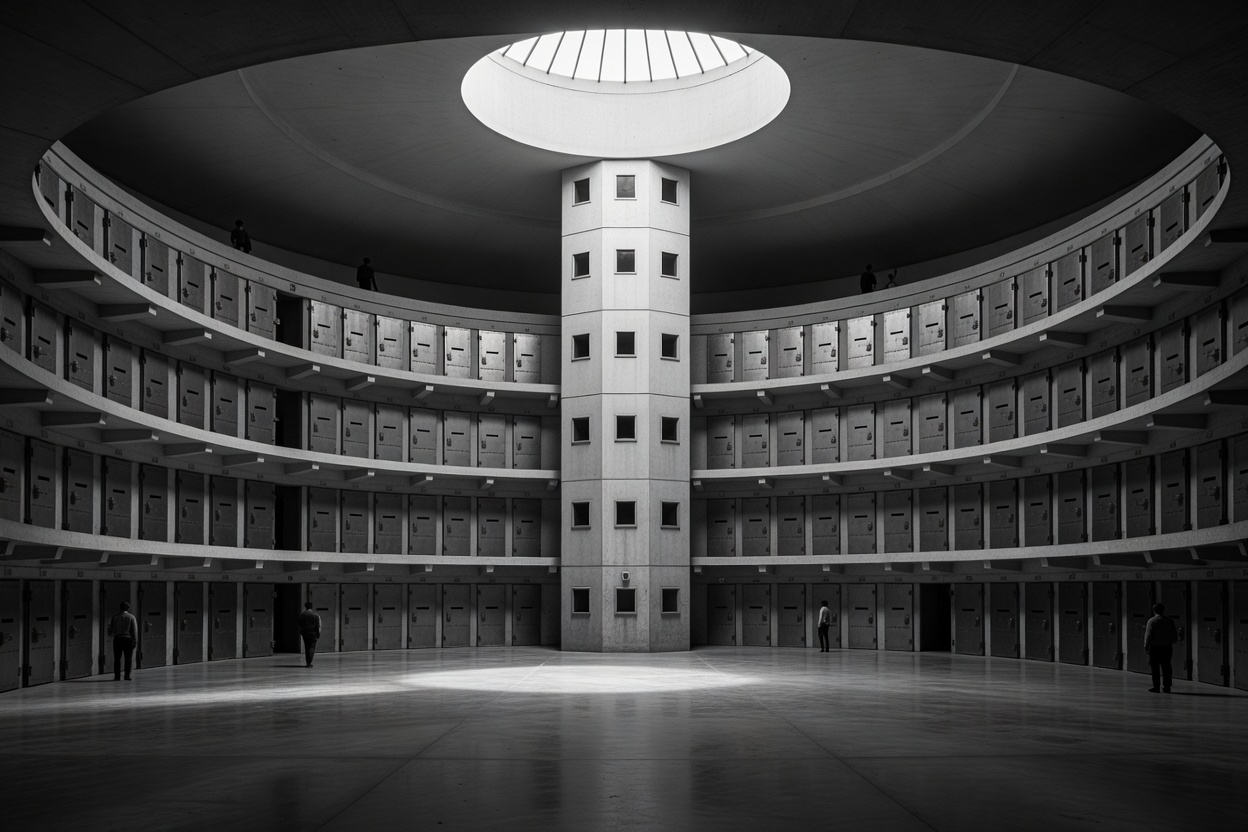
If prisoners can always be seen but never see the watcher, they will watch themselves.
Evidence
Jeremy Bentham drew a ring of cells around a central tower, lit so the watcher stays hidden. Britain never built his design, but its idea shaped later prisons, such as the round cellhouses at Stateville in Illinois (1925) and the Presidio Modelo in Cuba (1926–1928).
Sources: Jeremy Bentham, Panopticon; or, The Inspection-House (1791); Norman Johnston, Forms of Constraint: A History of Prison Architecture (2000).
Vincent van Gogh, Prisoners Exercising, 1890 · Pushkin State Museum of Fine Arts, Moscow · public domain
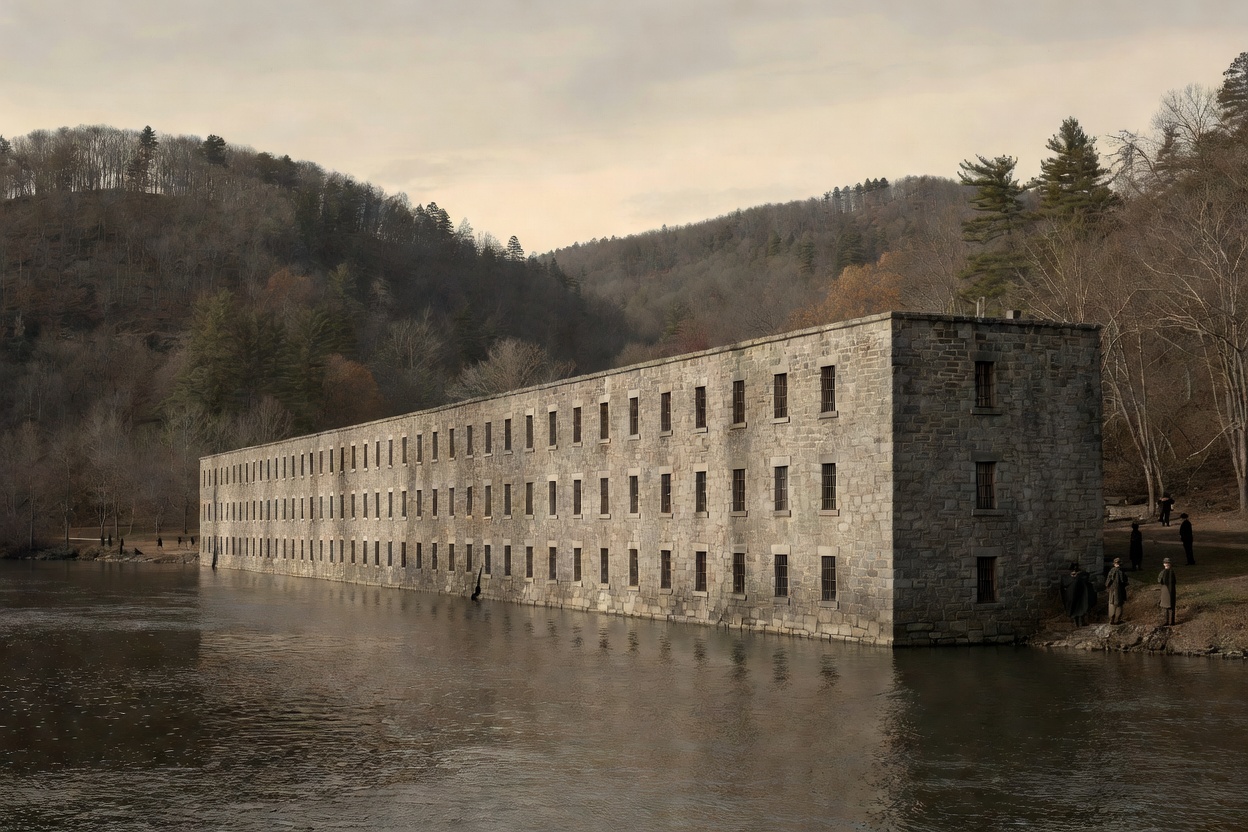
1829 vs 1816–1821 · Philadelphia and Auburn
Two American systems
Claim
Americans believed a prison could reform a person, and argued over how.
Evidence
Eastern State Penitentiary (1829) kept each prisoner alone, day and night, to reflect and repent: the Pennsylvania system. New York's Auburn prison had prisoners work together in silence by day and sleep alone: the congregate system. Auburn was cheaper and its workshops earned money, so most states copied it. Charles Dickens visited Eastern State in 1842 and wrote that long solitude hurt the mind more than the lash.
Ask
Why did cost decide the contest between two ideas about the soul?
Our prison table lists Eastern State (opened 1829, now closed). What is it today, and why keep it?
Sources: Charles Dickens, American Notes (1842), ch. 7; David Rothman, The Discovery of the Asylum (1971).
Illustration: Urbanicity house studio (SI-generated)
1876–1899 · reform era
The reformatory and the juvenile court
Claim
If a prison can reform, a sentence should end when the reform is done, not on a date.
Evidence
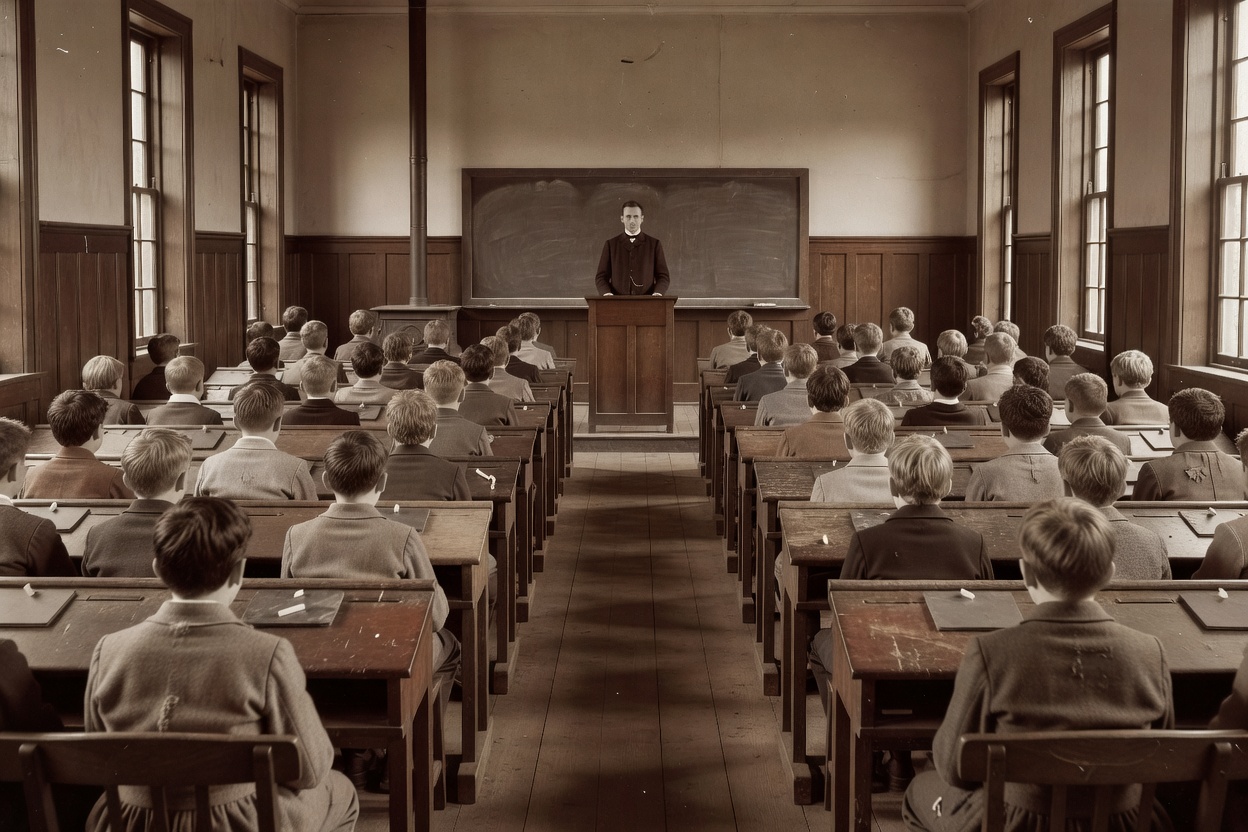
New York's Elmira Reformatory (1876) used grades, schooling and the indeterminate sentence, with release on parole. Chicago opened the first juvenile court in 1899, treating children as needing care, not punishment. In 1841 John Augustus, a Boston shoemaker, had already begun bailing people out and vouching for them: the start of probation.
Ask
Who decides when a person is "reformed," and what can go wrong?
Why might a judge prefer a fixed sentence to an open one?
Go deeper
Lesson:CR1.30 Probation, parole and the juvenile courtPreview
Source: David Rothman, Conscience and Convenience (1980).
Room 3 · labor as punishment
The lease, the gang and the county stockade
Illustration: Urbanicity house studio (SI-generated)
1865–1928 · the South
Convict leasing
Claim
After emancipation, Southern states used the criminal law to rebuild forced labor.
Evidence
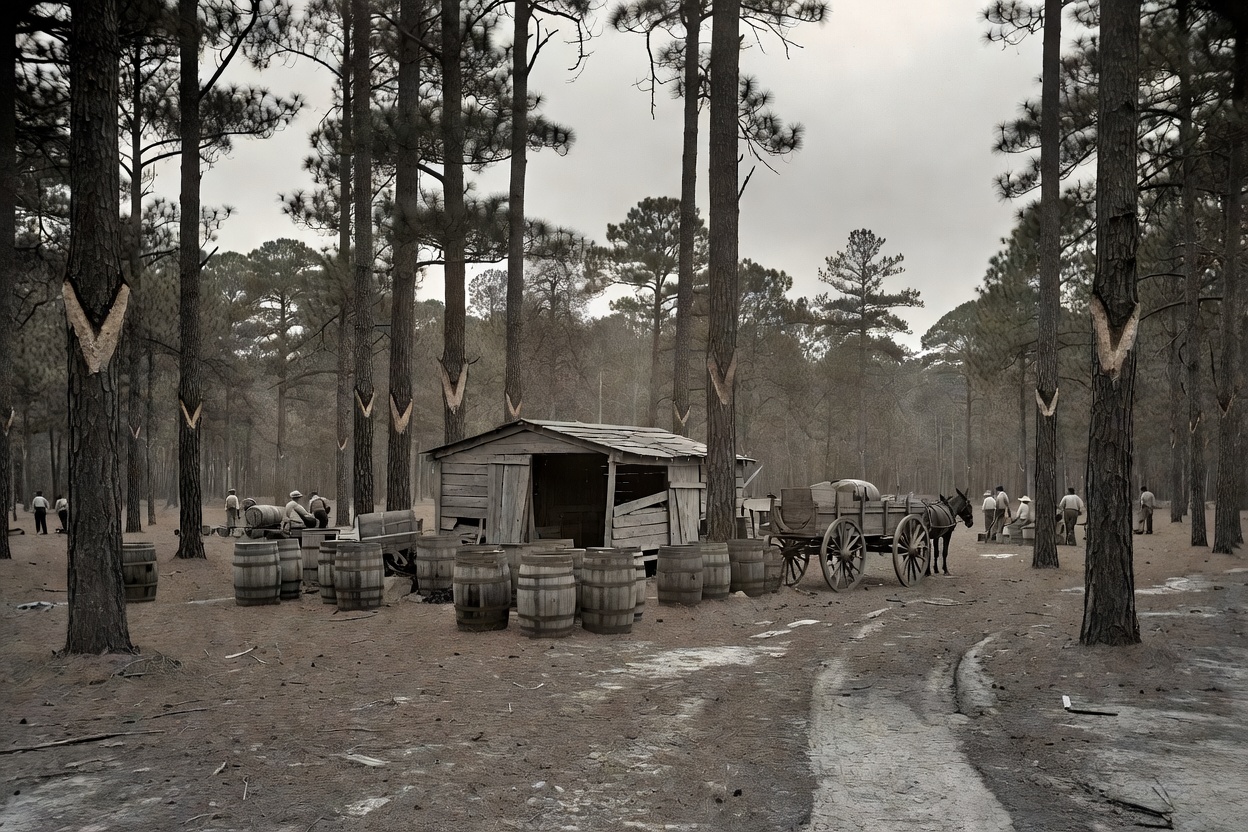
The Thirteenth Amendment (1865) ended slavery "except as a punishment for crime." Black Codes made vagrancy and loitering crimes, and states leased prisoners to mines, railroads, lumber camps and turpentine farms. Death rates in the camps were very high. Florida ended leasing in 1923 after Martin Tabert, a 22-year-old from North Dakota arrested for riding a train without a ticket, was whipped and died in a lumber camp in 1922. Alabama was the last state to end it, in 1928.
Ask
Read the exception clause of the Thirteenth Amendment. Why does it matter today?
Why did a white Northerner's death move Florida when thousands before had not?
Go deeper
Lessons:APUSH.13 The Reconstruction testPreviewAM3 Reconstruction: read the sourcePreviewCR1.32 Mass incarcerationPreview
Sources: Douglas Blackmon, Slavery by Another Name (2008); "Martin Tabert," Florida Memory and press of 1923.
Illustration: Urbanicity house studio (SI-generated)
1900s–1960s · roads
The chain gang
Claim
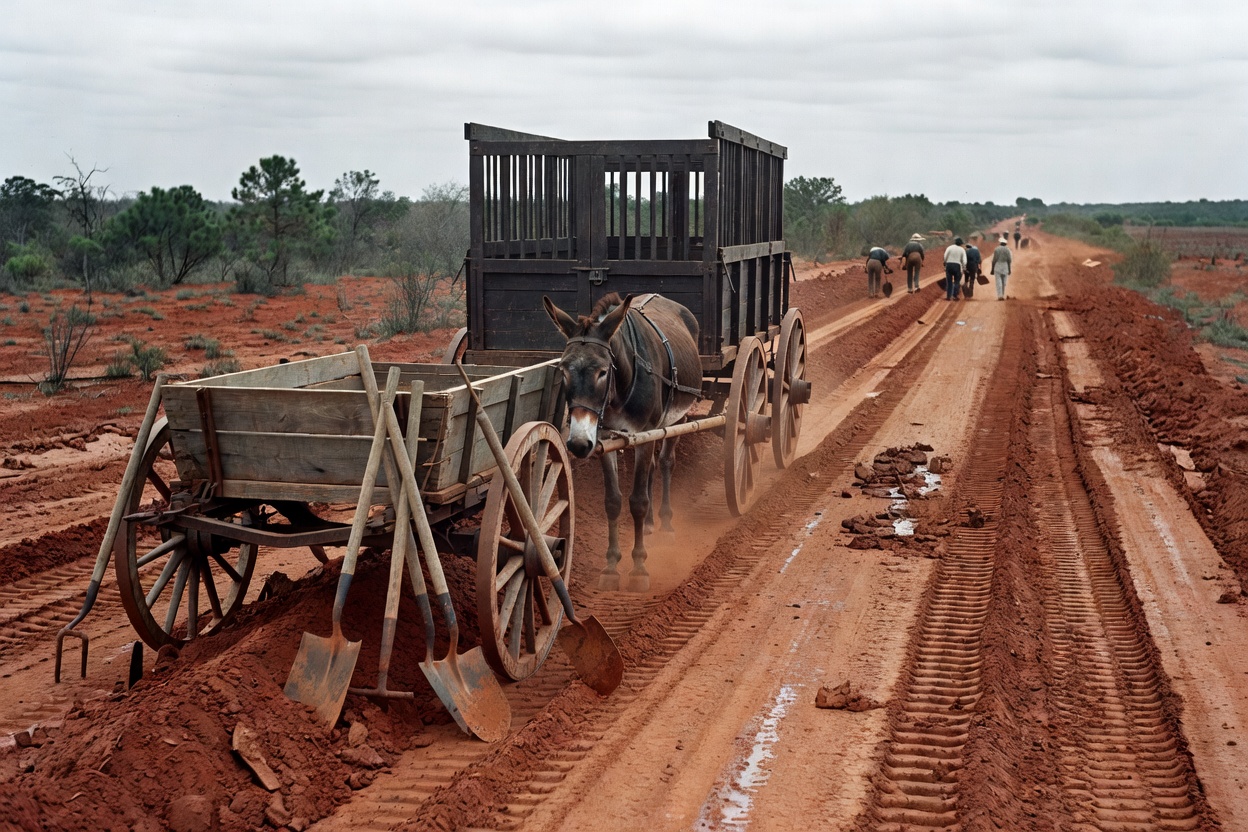
When leasing ended, the state kept the labor and put it to work on public roads.
Evidence
County and state road gangs, chained together and housed in camps, built much of the South's early highway network. Georgia's chain gangs drew national outrage after Robert Burns's 1932 memoir and the film made from it. Most states ended chained gangs by the 1960s. Alabama briefly brought them back in 1995 and stopped in 1996.
Ask
Who rode on the roads, and who built them?
Is prison labor today (license plates, firefighting crews) the same thing or different?
Go deeper
Lessons:CR1.32 Mass incarcerationPreviewAPUSH.14 Two Reconstructions, comparedPreview
Sources: Alex Lichtenstein, Twice the Work of Free Labor (1996); Robert E. Burns, I Am a Fugitive from a Georgia Chain Gang! (1932).
Illustration: Urbanicity house studio (SI-generated)
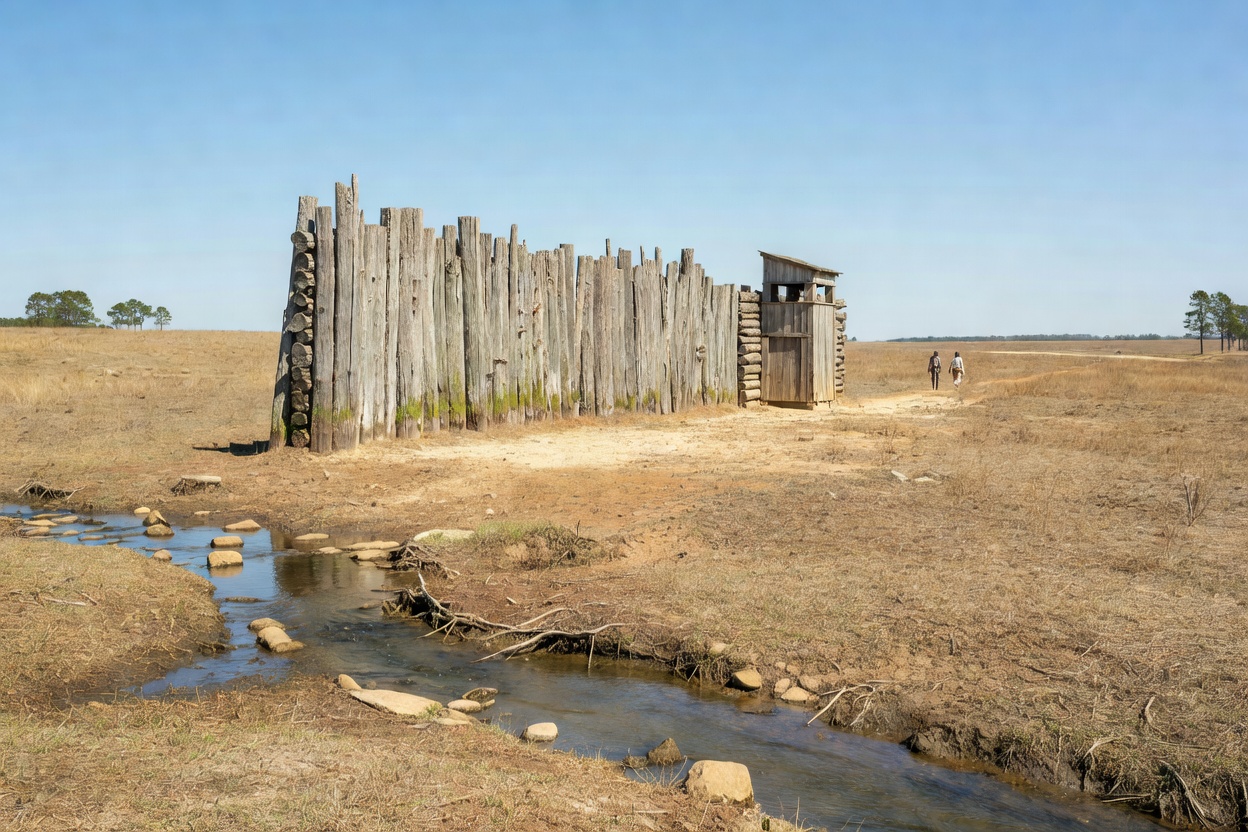
Florida counties · Manatee
The county stockade
Claim
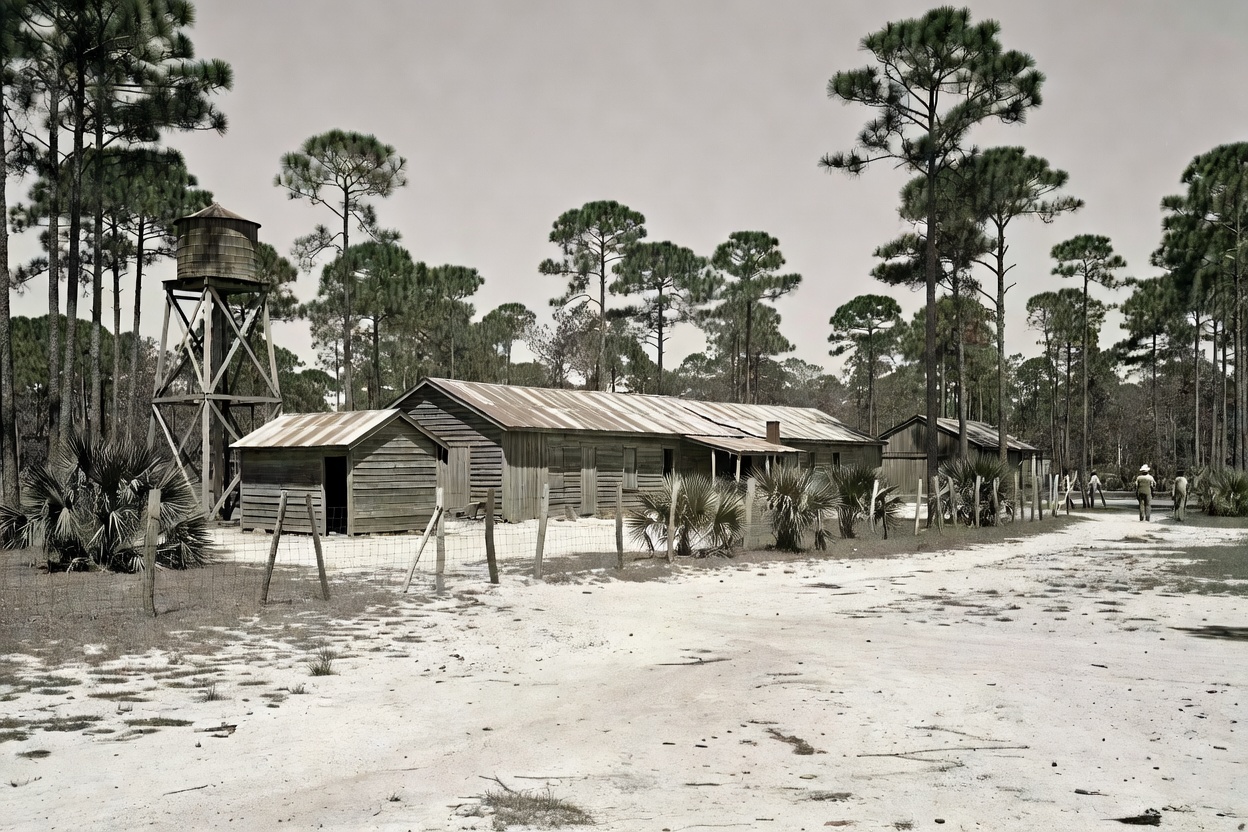
In Florida, "stockade" came to mean the county prison camp: a fenced compound where county prisoners lived and from which they worked roads and public jobs.
Evidence
After 1923, Florida counties kept their own prisoners on road work, housed in county camps and stockades. In Manatee County the word is older: in the Indian scare of 1856, Dr. Franklin Branch's home on the Manatee River was ringed by a stockade where settlers took shelter. That stockade was for protection, not punishment.
To verifyWe have not yet found a primary source dating Manatee County's own county prison camp or stockade, where it stood, or when it closed. The clerk's Historical Resources office and the Manatee County commission minutes are the next places to look. Nothing on this card about a Manatee camp should be taught as fact until that record is found.
Ask
Find your county's old jail or road camp. What stands on the site now?
Why did counties, not the state, keep road prisoners?
Go deeper
Lessons:CR1.33 Inside: the corrections officerPreviewSO1.26 Public history: memorials and museumsPreview
Sources: "Historical Sketch of Manatee County," Florida Memory (State Archives of Florida), item 321135; Manatee County Clerk, Historical Resources (to check).
Room 4 · the prison nation
Mass incarceration, private prisons and the hole
Illustration: Urbanicity house studio (SI-generated)
1972–today · United States
From under 200,000 to 1.6 million
Claim
Starting in the 1970s the United States built the largest prison system in the world, by choice, not because crime alone demanded it.
Evidence
State and federal prisons held under 200,000 people in the early 1970s and about 1.6 million at the 2009 peak. At the end of 2023 they held 1,254,224 (Bureau of Justice Statistics), not counting local jails. Longer sentences, mandatory minimums, the war on drugs and three-strikes laws drove the rise. David Garland calls it a "culture of control"; Michelle Alexander calls it "the New Jim Crow."
Ask
Crime fell after the early 1990s. How much of that fall can prisons claim?
Use the map below: which states hold the most people? Is that just because they are big?
Go deeper
Lessons:CR1.32 Mass incarcerationPreviewCR1.31 "Nothing works" and long sentencesPreview
Sources: BJS, Prisoners in 2023, Table 2; National Research Council, The Growth of Incarceration in the United States (2014). Schematic; three anchor points only.
Illustration: Urbanicity house studio (SI-generated)
1983–today · the market
Private prisons
Claim
Supporters said private companies would build faster and run prisons cheaper; critics said profit should never depend on how many people are locked up.
Evidence
Corrections Corporation of America was founded in Tennessee in 1983 and renamed CoreCivic in 2016. Wackenhut Corrections became the GEO Group in 2003. Private firms hold a small share of all prisoners but a large share of immigration detainees. A January 2021 executive order told the Justice Department not to renew private federal prison contracts; it was rescinded in January 2025. Our prison table includes a CoreCivic site in Clifton, Tennessee (1992) and GEO's Northwest Detention Center in Tacoma, Washington (2004).
Ask
A contract guarantees a company that 90% of its beds will be filled. What problem does that create?
Public prisons have budgets, unions and jobs too. Is the profit motive really different?
Go deeper
Lessons:CR1.32 Mass incarcerationPreviewCR1.33 Inside: the corrections officerPreview
Sources: The Sentencing Project, "Private Prisons in the United States" (updated yearly); Executive Order 14006 (Jan. 26, 2021).
Illustration: Urbanicity house studio (SI-generated)
1983–today · control
Supermax and solitary
Claim
The Pennsylvania system came back in concrete: the supermax keeps people alone in a cell for 22 to 24 hours a day.
Evidence
After two guards were killed at the federal prison in Marion, Illinois in 1983, it went into permanent lockdown. ADX Florence in Colorado opened in 1994 as the federal supermax. The United Nations' Nelson Mandela Rules (2015) call solitary confinement for more than 15 days in a row "prolonged" and forbid it.
Ask
Compare Dickens on Eastern State (1842) with today's research on solitary. What has changed?
Is there a safe way to hold the most dangerous prisoners?
Go deeper
Lessons:CR1.33 Inside: the corrections officerPreviewCR1.31 "Nothing works" and long sentencesPreview
Sources: UN Standard Minimum Rules for the Treatment of Prisoners (Mandela Rules), Rules 43–44 (2015); Lorna Rhodes, Total Confinement (2004).
Room 5 · the ultimate penalty
The death penalty in the United States
Illustration: Urbanicity house studio (SI-generated)
1972–1976 · the Supreme Court
Stopped, then restarted
Claim
The Court never ruled the death penalty itself unconstitutional, only the way it was handed out.
Evidence
Furman v. Georgia (1972) struck down death sentences as arbitrary. States rewrote their laws, and Gregg v. Georgia (1976) allowed executions to resume under guided procedures. Utah carried out the first one under the new laws in 1977. Later cases barred executing people with intellectual disability (Atkins, 2002), people under 18 at the crime (Roper, 2005) and executing for crimes other than murder against an individual (Kennedy v. Louisiana, 2008).
Ask
What does "arbitrary" mean, and how could a law fix it?
Each limit the Court added came from "evolving standards of decency." Who decides what those are?
Go deeper
Lessons:APGOV.13 Incorporation and due processPreviewCR1.35 Capstone: the case filePreview
Sources: Furman v. Georgia, 408 U.S. 238 (1972); Gregg v. Georgia, 428 U.S. 153 (1976).
Illustration: Urbanicity house studio (SI-generated)
1977–2023 · the numbers
Who is on death row, and where
Claim
The death penalty is national in law but local in practice: a few states, and a few counties within them, carry out most executions.
Evidence
At the end of 2023, 2,192 people were under sentence of death, in 26 states and the federal system; California held the most (653) but had carried out 13 executions since 1977, while Texas carried out 586. From 1977 to 2023 there were 1,582 executions in all (BJS). Use the map's two layers to see the gap between sentencing and executing.
Ask
Why might a state keep a large death row but rarely execute?
Which matters more for the people involved: the sentence, or the execution?
Go deeper
Lessons:CR1.8 Rates per 100,000PreviewCR1.35 Capstone: the case filePreview
Source: BJS, Capital Punishment, 2023 – Statistical Tables, Tables 2 and 8.
Room 6 · what is being tried now
Alternatives to the cell
Illustration: Urbanicity house studio (SI-generated)
1841–today
Probation and parole
Claim
Most people under correctional control in the US are not behind bars at all.
Evidence
Probation (supervision instead of prison) and parole (supervised release after prison) together cover more people than prisons and jails combined. Critics note that missed appointments and rule breaks send many back inside without a new crime.
Ask
What rules would you set for someone on probation, and which could trap them?
Go deeper
Lessons:CR1.30 Probation, parole and the juvenile courtPreviewCR1.34 Coming home: reentryPreview
Source: BJS, Probation and Parole in the United States (annual series).
Illustration: Urbanicity house studio (SI-generated)
1989–today
Drug courts and problem-solving courts
Claim
Some crimes come from a problem, such as addiction, that a judge can supervise better than a prison can fix.
Evidence
The first drug court opened in Miami-Dade County in 1989: treatment, testing and frequent hearings in place of a sentence. Thousands now exist, along with mental-health and veterans courts.
Ask
Who should be allowed into a drug court, and who left out?
Go deeper
Lessons:CR1.30 Probation, parole and the juvenile courtPreviewCR1.34 Coming home: reentryPreview
Source: National Institute of Justice, "Drug Courts" (overview page).
Illustration: Urbanicity house studio (SI-generated)
1983–today
The ankle monitor
Claim
Electronic monitoring moves the watched cell into the home: Bentham's tower, worn on the leg.
Evidence
A New Mexico judge, Jack Love, began using an electronic ankle bracelet in 1983. GPS monitoring now follows people on pretrial release, probation, parole and immigration cases, often at the wearer's own cost.
Ask
Is a monitor a kinder punishment or a wider net? Use Foucault to argue one side.
Go deeper
Lessons:CR1.30 Probation, parole and the juvenile courtPreviewCR1.34 Coming home: reentryPreview
Source: National Institute of Justice, electronic monitoring topic pages (nij.ojp.gov); the 1983 Albuquerque trial by Judge Jack Love is the standard starting date.
Illustration: Urbanicity house studio (SI-generated)
1970s–today
Restorative justice
Claim
Crime is first a harm to people and relationships, and justice should repair it.
Evidence
Howard Zehr's Changing Lenses (1990) set out the idea: victim and offender meet, with the community, and agree on repair. New Zealand made family group conferences the standard path for young offenders in 1989.
Ask
When would a victim refuse to meet? Should the process still go on?
Go deeper
Lessons:CR1.34 Coming home: reentryPreviewCR1.35 Capstone: the case filePreview
Source: Howard Zehr, Changing Lenses (1990); New Zealand, Children, Young Persons, and Their Families Act 1989.
Illustration: Urbanicity house studio (SI-generated)
2010–today · Norway
The Nordic model: Halden
Claim
If almost every prisoner comes home, the prison should look like the home they will return to.
Evidence
Halden prison in Norway (opened 2010) has private rooms, kitchens, schooling and officers trained for two years who work alongside prisoners. Norway's guiding idea is "normality": the loss of liberty is the punishment, nothing more. Its sentences are short and its reoffending rates are among the lowest measured.
Ask
Norway is small and wealthy. What would carry over to a US state, and what would not?
Go deeper
Lessons:CR1.34 Coming home: reentryPreviewCR1.33 Inside: the corrections officerPreview
Source: Norwegian Correctional Service (Kriminalomsorgen), principle of normality; John Pratt, "Scandinavian Exceptionalism," British Journal of Criminology (2008).
Room 7 · notorious prisons of the world
Twenty prisons the world remembers
Fortresses, islands, camps and city jails whose names became shorthand for punishment, uprising or reform. Click a dot to open its card. Devil's Island is in Room 1, under transportation.
Closed, demolished or a museumStill holding people
Illustration: Urbanicity house studio (SI-generated)
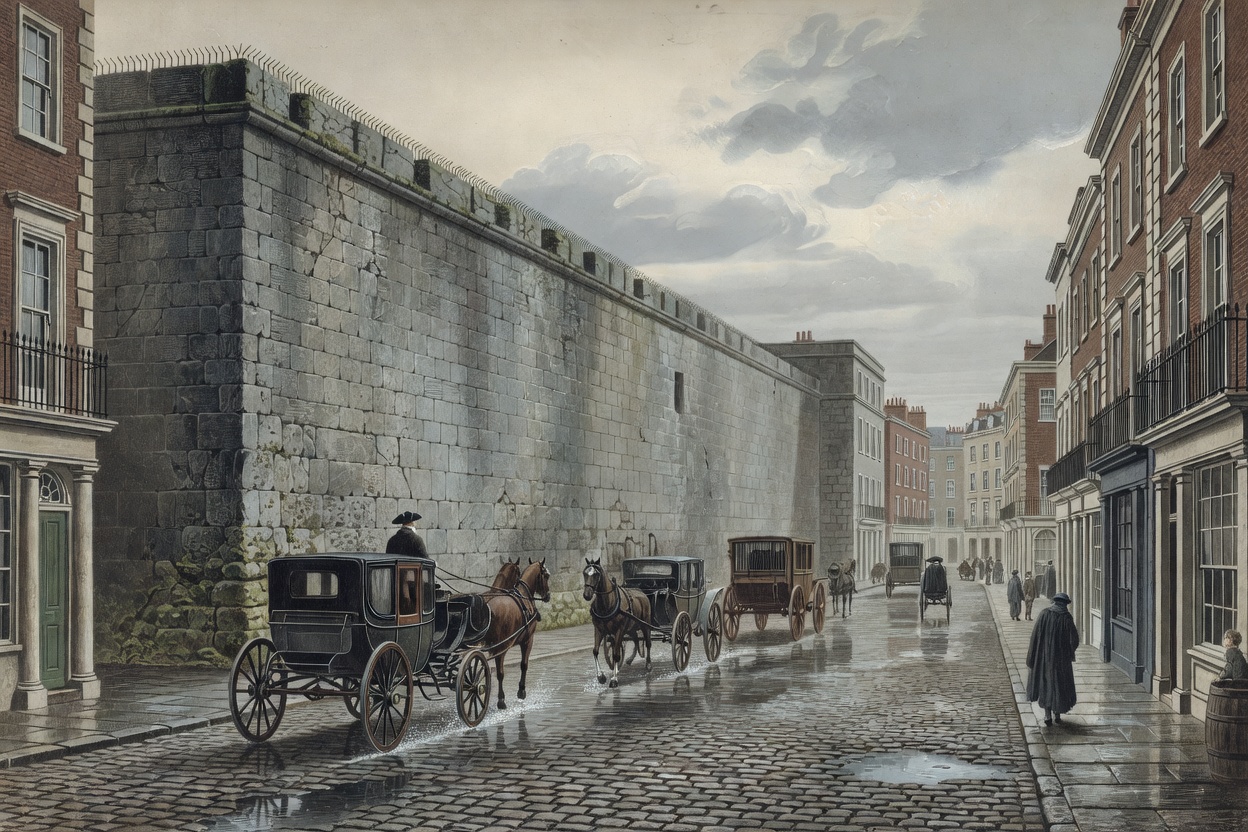
c. 1188–1902 · London
Newgate Prison
Where
City of London, England · opened 12th century · closed 1902
Claim
For seven centuries London's main jail held debtors, people awaiting trial and the condemned. From 1783 public hangings moved from Tyburn to the street outside its walls, and crowds gathered there until 1868.
Why it is notorious
Overcrowding, disease and "gaol fever" made Newgate a byword for misery. Elizabeth Fry's visits from 1813 to its women's side helped start British prison reform.
Today
Demolished 1902; the Central Criminal Court (the Old Bailey) stands on the site.
Ask
Why did reformers start with the conditions of women and children?
Illustration: Urbanicity house studio (SI-generated)
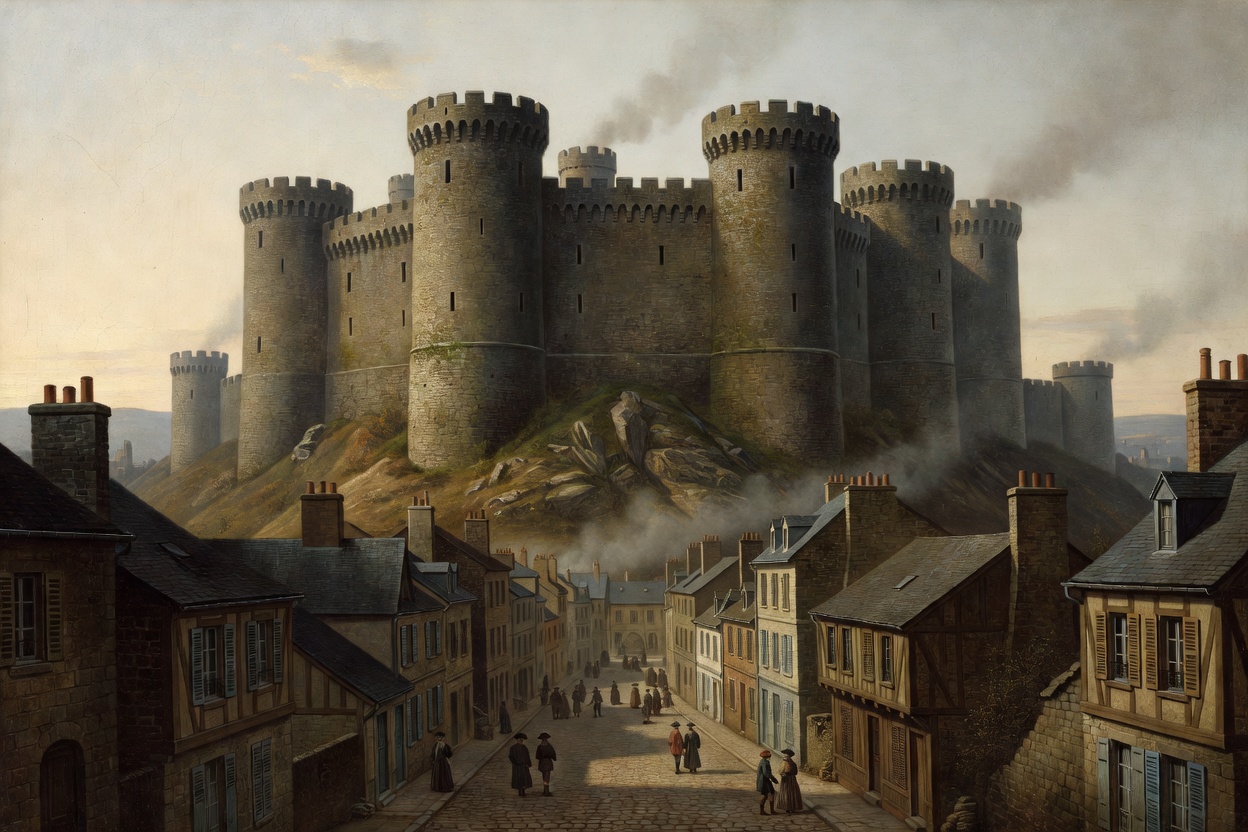
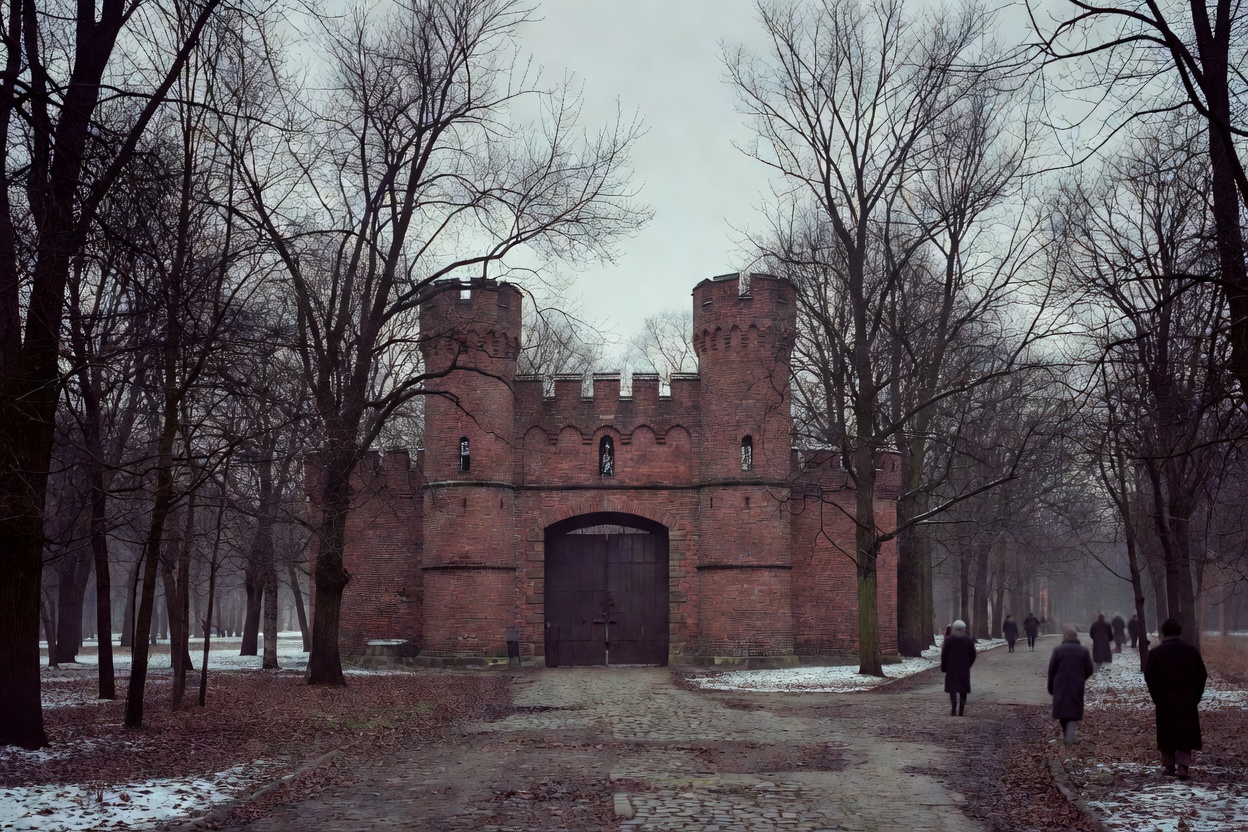
1370–1789 · Paris
The Bastille
Where
Paris, France · opened 1370s (fortress) · closed 1789
Claim
A medieval fortress used by French kings to hold prisoners by royal order (lettre de cachet), without trial. It held writers and nobles as well as forgers and the unlucky.
Why it is notorious
On 14 July 1789 a Paris crowd stormed it for its gunpowder and freed its seven prisoners; its fall became the symbol of the French Revolution, and the fortress was pulled down stone by stone.
Today
Demolished 1789–90; the Place de la Bastille marks the site.
Ask
Why did a nearly empty prison become a symbol worth storming?
Go deeper
Lessons:APEURO.5 The Enlightenment benchPreviewAPWH.12 Revolutions in an Atlantic mirrorPreview
Illustration: Urbanicity house studio (SI-generated)
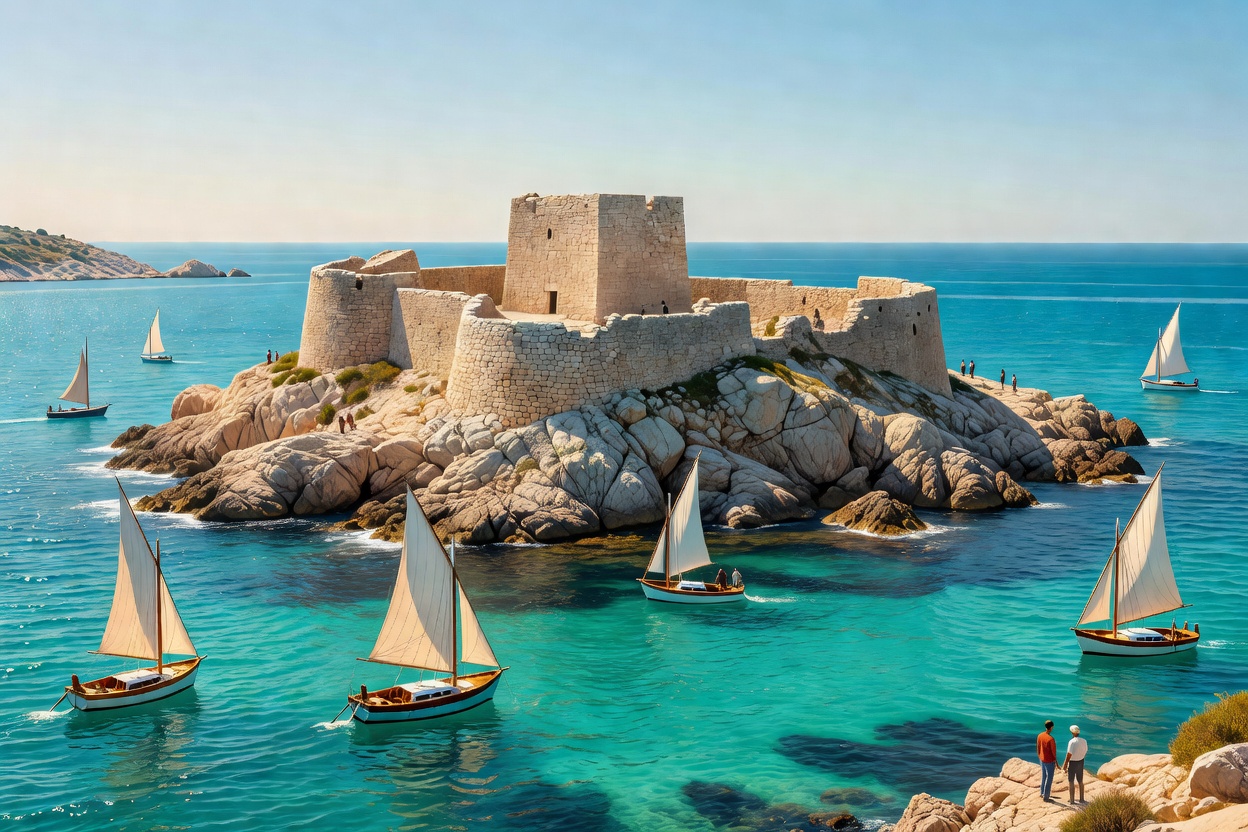
1580s–1890 · Marseille
Château d'If
Where
Off Marseille, France · opened 1531 (fort) · closed 1890 (as prison)
Claim
A small island fortress in the bay of Marseille used as a state prison for political and religious prisoners, including thousands of Protestants after 1685.
Why it is notorious
Alexandre Dumas made it famous as the prison of Edmond Dantès in The Count of Monte Cristo (1844), so a fictional prisoner is its best-known inmate.
Today
A national monument open to visitors.
Ask
How does a novel change what visitors expect from a real prison?
Go deeper
Lesson:SO1.26 Public history: memorials and museumsPreview
Illustration: Urbanicity house studio (SI-generated)
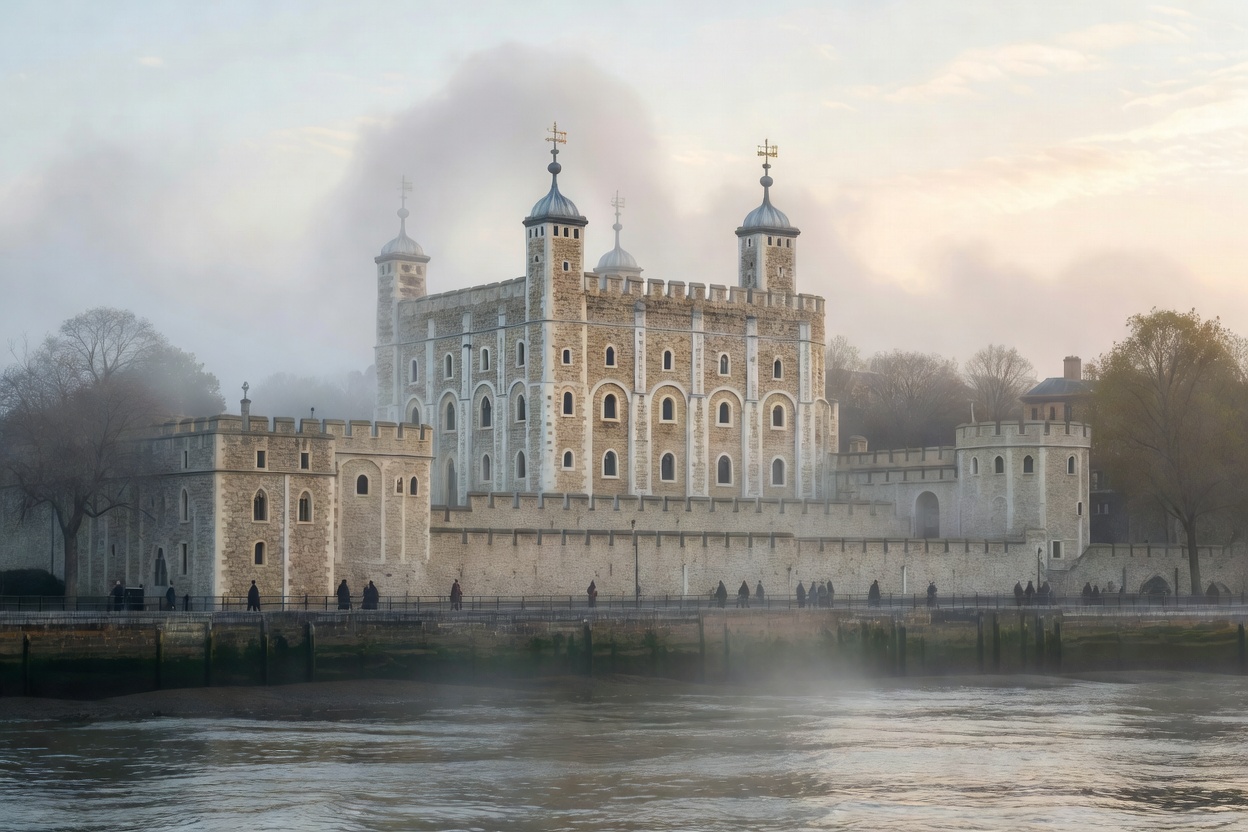
1070s–1952 · London
The Tower of London
Where
London, England · opened 1070s · still standing
Claim
A royal fortress that also served as a prison for nobles, rebels and political prisoners for almost nine centuries.
Why it is notorious
Executions on Tower Green and the stories of prisoners held there, from medieval princes to Tudor queens, made it the most famous prison in English history; its last prisoners were held during the Second World War.
Today
A royal palace, museum and World Heritage Site.
Ask
Why were high-status prisoners kept in a palace-fortress rather than a common jail?
Go deeper
Lesson:SO1.26 Public history: memorials and museumsPreview
Illustration: Urbanicity house studio (SI-generated)
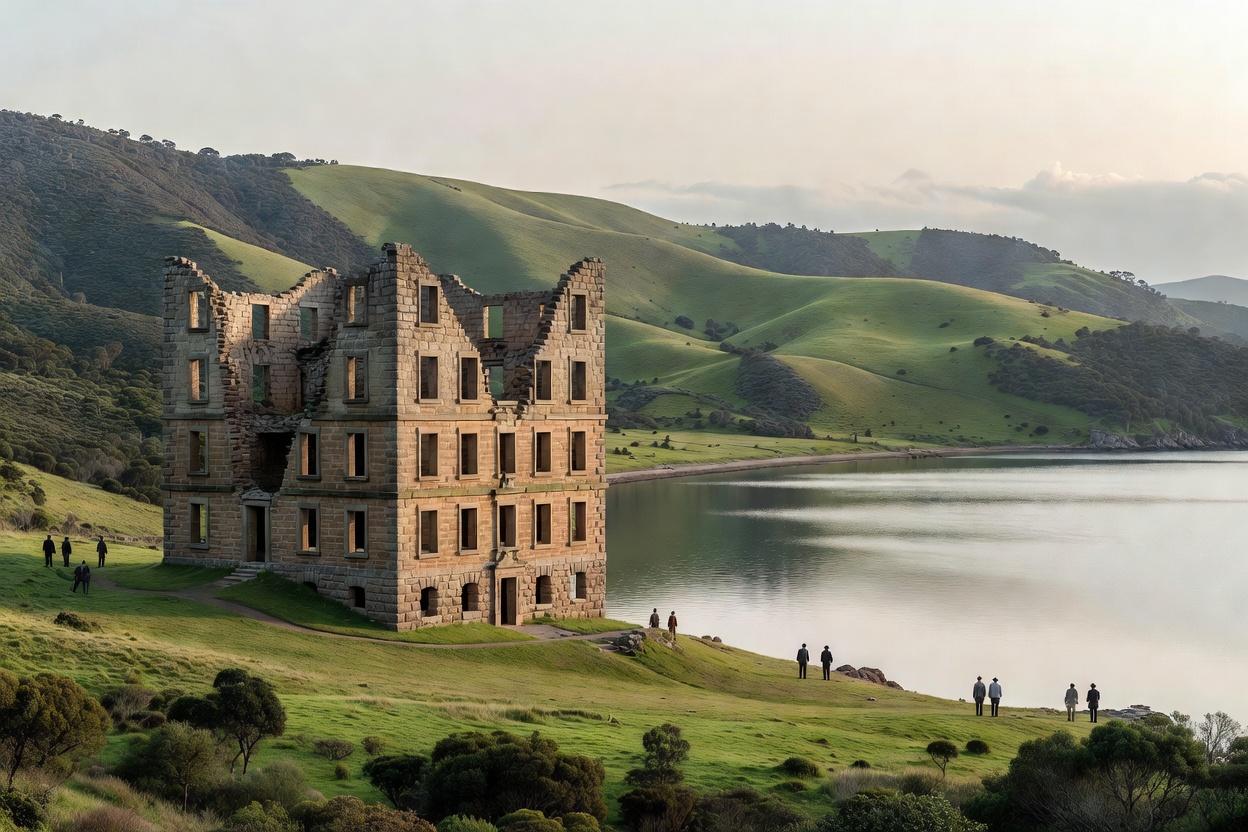
1830–1877 · Van Diemen's Land
Port Arthur
Where
Tasmania, Australia · opened 1830 · closed 1877
Claim
A penal settlement for convicts who reoffended after transportation, on a peninsula guarded by water and a narrow neck of land.
Why it is notorious
It tried every theory of the age: hard labor, a boys' prison at Point Puer, and a Separate Prison built on the Pennsylvania model of silence and isolation.
Today
A World Heritage Site and museum (Australian Convict Sites).
Ask
Compare the Separate Prison with Eastern State: what did Britain copy from America?
Go deeper
Lessons:APWH.10 The Atlantic systemPreviewCR1.29 The penitentiary ideaPreview
Illustration: Urbanicity house studio (SI-generated)
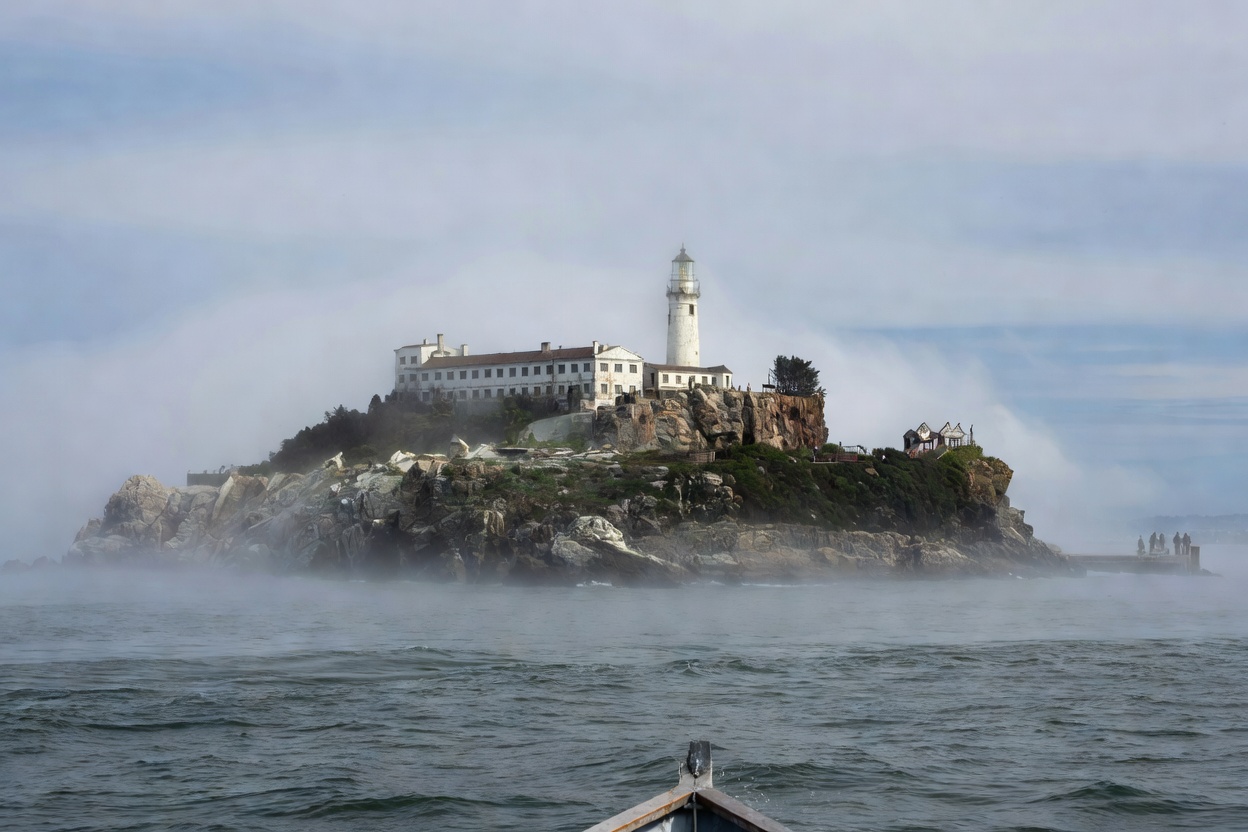
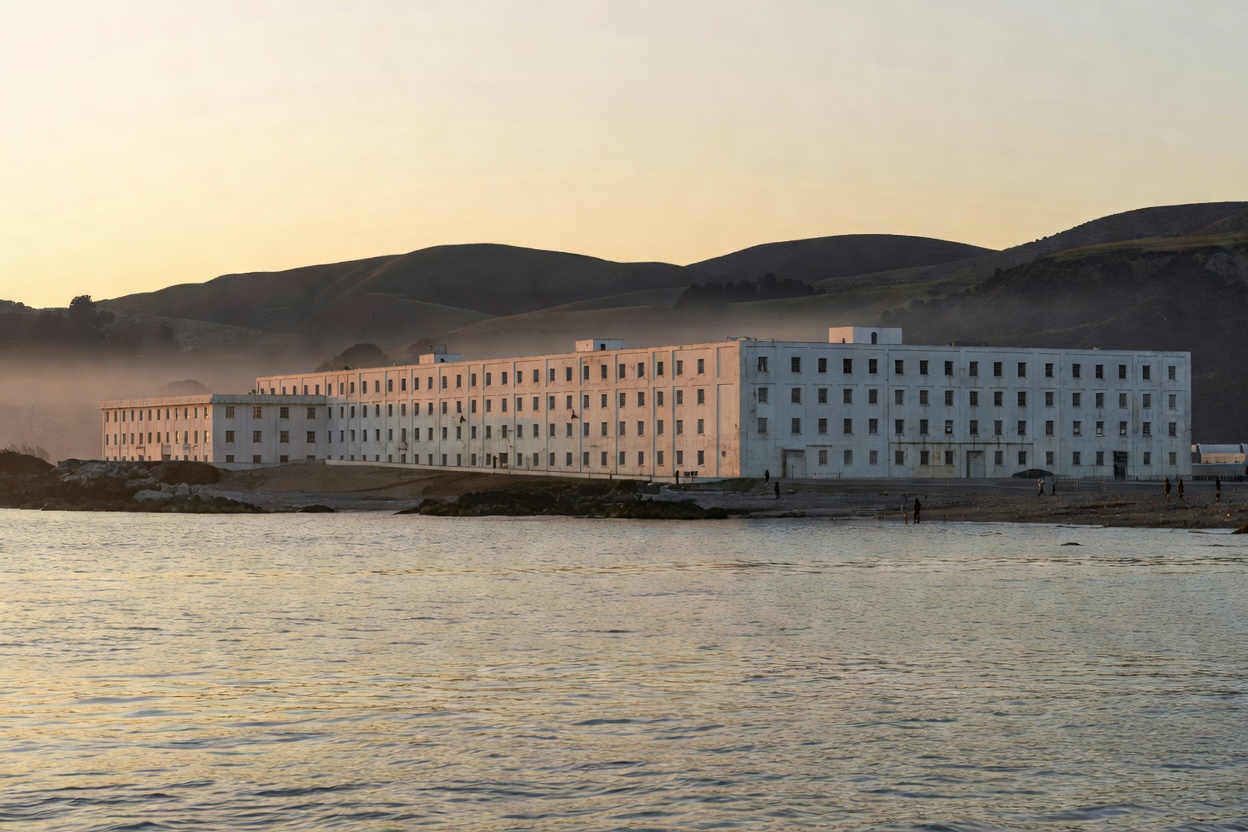
1934–1963 · San Francisco
Alcatraz
Where
San Francisco Bay, United States · opened 1934 (federal penitentiary) · closed 1963
Claim
A federal penitentiary on a rock in San Francisco Bay for prisoners other prisons could not hold, run on strict rules: one man to a cell, privileges earned.
Why it is notorious
Cold currents made escape nearly impossible; the 1962 escape attempt by three men has never been solved. High costs closed it in 1963, and in 1969–71 Native activists occupied the island.
Today
Part of the Golden Gate National Recreation Area, run by the National Park Service; proposals to reopen it as a prison were raised in 2025. (checked 1 Nov 2026)
Ask
Why would a government spend so much on a prison for a few hundred men?
Go deeper
Lesson:CR1.33 Inside: the corrections officerPreview
Illustration: Urbanicity house studio (SI-generated)
1852–today · California
San Quentin
Where
Marin County, California, United States · opened 1852 · still open
Claim
California's oldest prison, begun on a prison ship in the bay during the Gold Rush. It held the state's largest death row for decades.
Why it is notorious
Its history runs from brutal early conditions to education programs, a prison newspaper and a podcast made inside. California has paused executions since 2019 and moved its death row elsewhere.
Today
Operating; being converted into the San Quentin Rehabilitation Center under a plan announced in 2023. (checked 1 Nov 2026)
Ask
Can a prison known for its death row become known for rehabilitation?
Illustration: Urbanicity house studio (SI-generated)
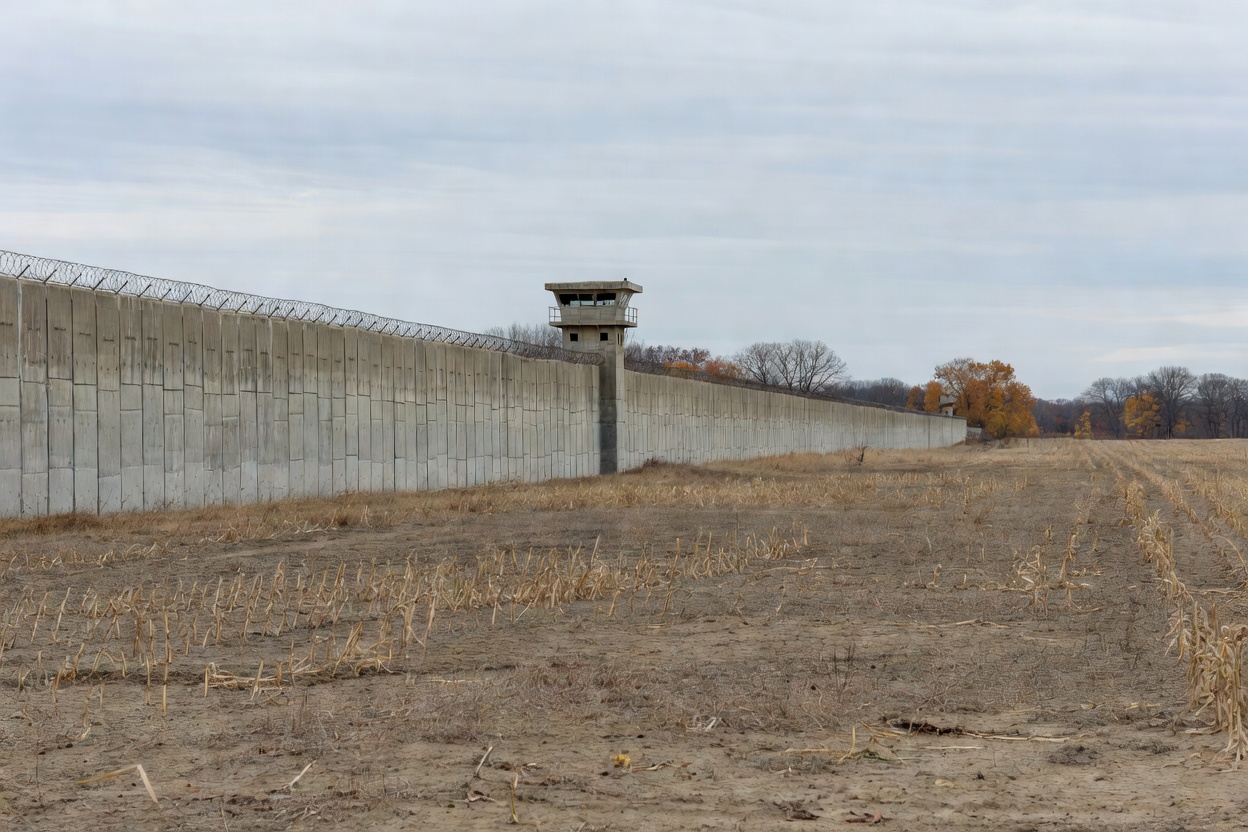
1931–today · New York
Attica
Where
Attica, New York, United States · opened 1931 · still open
Claim
A maximum-security prison where, in September 1971, about 1,300 prisoners took control of a yard and held hostages, demanding better conditions.
Why it is notorious
After four days of negotiation, state police retook the prison; 43 people died, most of them killed in the assault. The state's McKay Commission called it, apart from the Indian massacres of the late 1800s, the bloodiest one-day encounter between Americans since the Civil War.
Today
An operating state prison (Attica Correctional Facility). (checked 1 Nov 2026)
Ask
What did the prisoners ask for, and how many of those demands are now law?
Illustration: Urbanicity house studio (SI-generated)
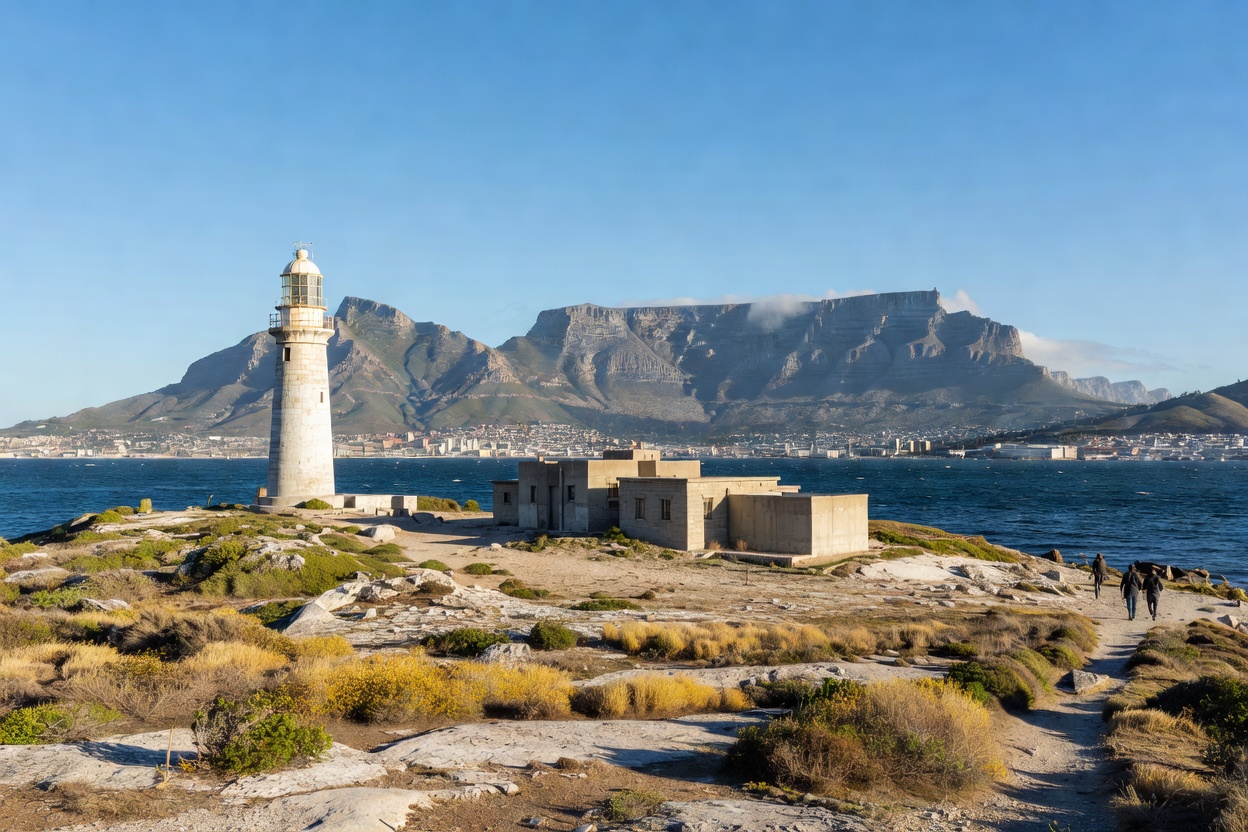
1600s–1996 · South Africa
Robben Island
Where
Table Bay, Cape Town, South Africa · opened 17th century · closed 1996
Claim
An island prison used for centuries for exiles and lepers and, under apartheid, for political prisoners. Nelson Mandela spent 18 of his 27 years in prison there.
Why it is notorious
Political prisoners turned the lime quarry and the cells into a "university," teaching each other; the island became a symbol of the struggle against apartheid.
Today
A museum and World Heritage Site; former prisoners have worked as guides.
Ask
How can a prison become a school?
Go deeper
Lesson:SO1.26 Public history: memorials and museumsPreview
Illustration: Urbanicity house studio (SI-generated)
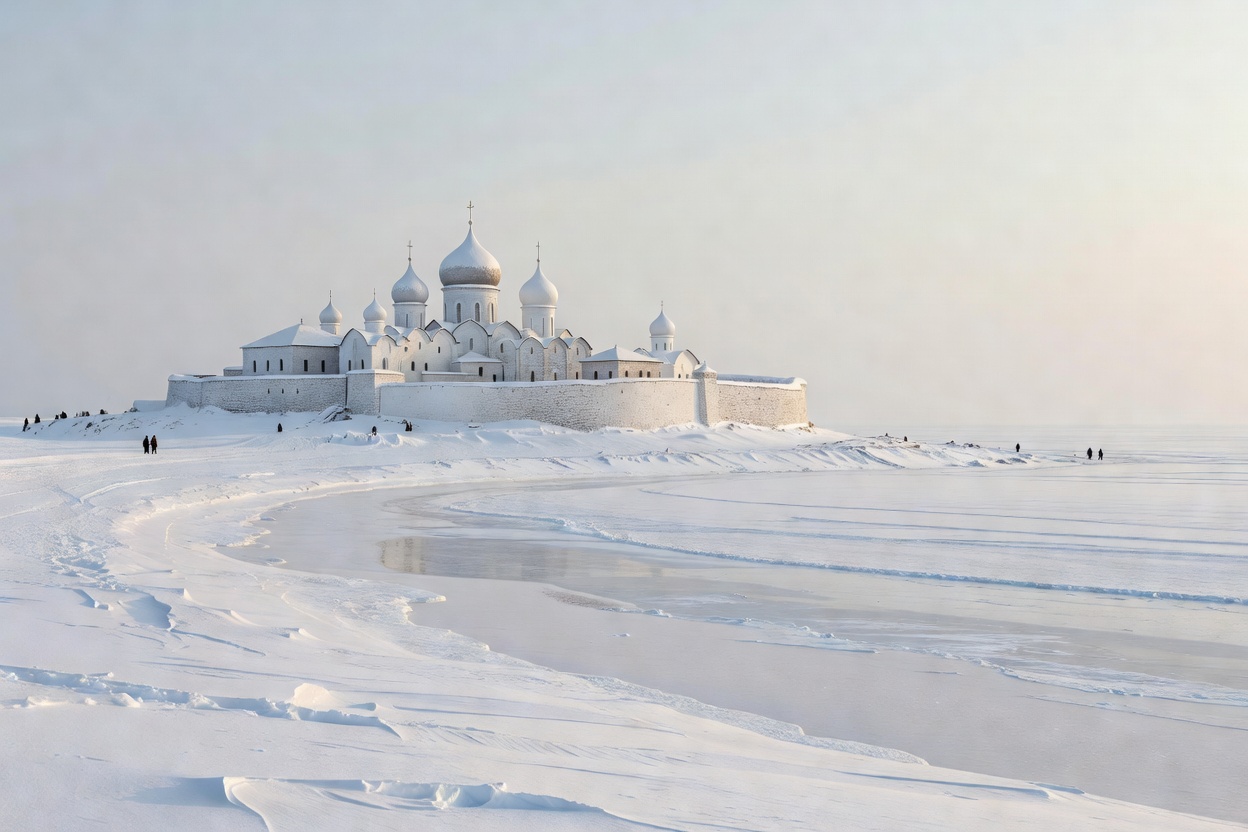
1923–1939 (Solovki) · 1930–1960 (Gulag)
Solovki and the Gulag
Where
Solovetsky Islands, White Sea, Russia · opened 1923 · closed 1939 (Solovki)
Claim
A medieval monastery on the White Sea became the first Soviet special camp in 1923, the model for the Gulag: a system of forced-labor camps that held millions.
Why it is notorious
Prisoners, many convicted for political reasons, cut timber, mined and built canals in deadly cold. Aleksandr Solzhenitsyn called Solovki the mother of the Gulag.
Today
The monastery is active again and a World Heritage Site; a memorial stone honours camp victims.
Ask
How did a labor camp system serve an economy as well as a government?
Go deeper
Lesson:APWH.12 Revolutions in an Atlantic mirrorPreview
Illustration: Urbanicity house studio (SI-generated)
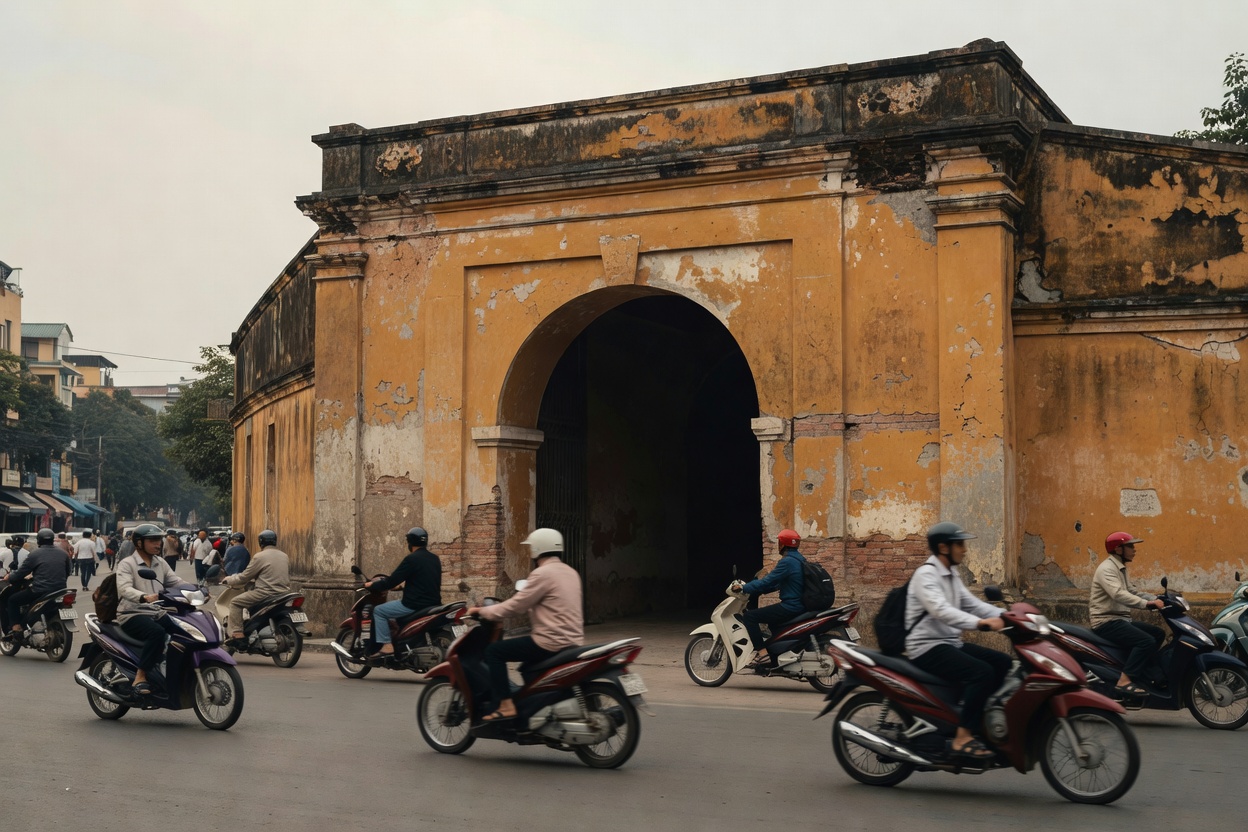
1896–1993 · Hanoi
Hỏa Lò Prison
Where
Hanoi, Vietnam · opened 1896 · closed 1993
Claim
Built by the French colonial government to hold Vietnamese political prisoners, it was later used by North Vietnam to hold American prisoners of war.
Why it is notorious
American POWs called it the "Hanoi Hilton." Both French-era prisoners and American airmen described harsh treatment; the museum today tells mainly the colonial story.
Today
Mostly demolished in the 1990s; the gatehouse is a museum.
Ask
How does a museum choose whose story to tell first?
Go deeper
Lesson:SO1.26 Public history: memorials and museumsPreview
Illustration: Urbanicity house studio (SI-generated)
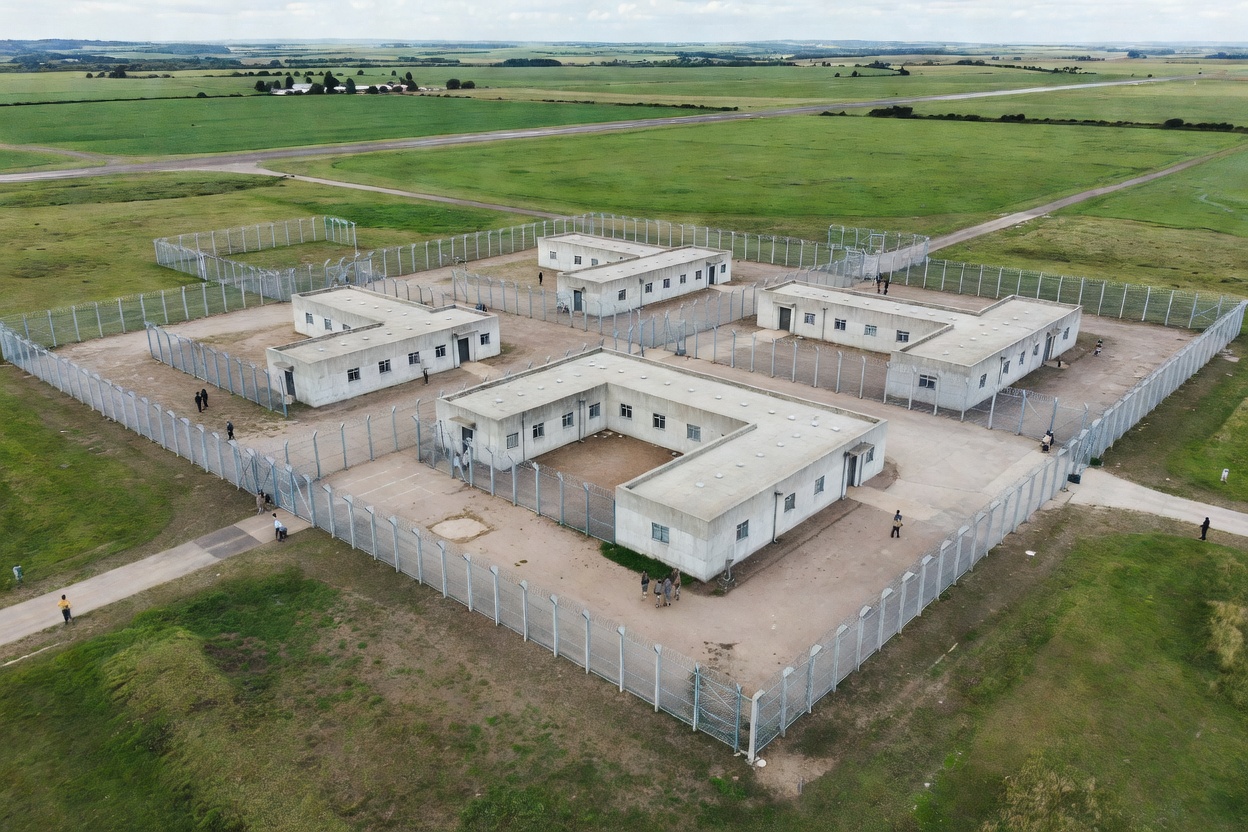
1971–2000 · Northern Ireland
Long Kesh / the Maze
Where
Lisburn, Northern Ireland, United Kingdom · opened 1971 · closed 2000
Claim
Built on an airfield to intern people without trial during the Troubles, it later held prisoners convicted in the conflict in its H-shaped blocks.
Why it is notorious
Prisoners' protests for political status led to the 1981 hunger strikes, in which ten men died; the prison emptied after the 1998 Good Friday Agreement.
Today
Mostly demolished; the future of the remaining buildings is still debated.
Ask
Should a prison from a conflict be kept as a museum, or removed?
Go deeper
Lesson:APGOV.13 Incorporation and due processPreview
Illustration: Urbanicity house studio (SI-generated)
1950s–2014 · Iraq
Abu Ghraib
Where
Near Baghdad, Iraq · opened 1950s · closed 2014
Claim
A prison used under Saddam Hussein's government for political prisoners and executions, then by the US-led coalition after 2003.
Why it is notorious
In 2004 photographs revealed abuse of Iraqi detainees by US military police; courts-martial and investigations followed, and the scandal changed US detention and interrogation policy debates.
Today
Closed by Iraq in 2014.
Ask
How do chains of command and photographs shape accountability?
Go deeper
Lesson:APGOV.13 Incorporation and due processPreview
Illustration: Urbanicity house studio (SI-generated)
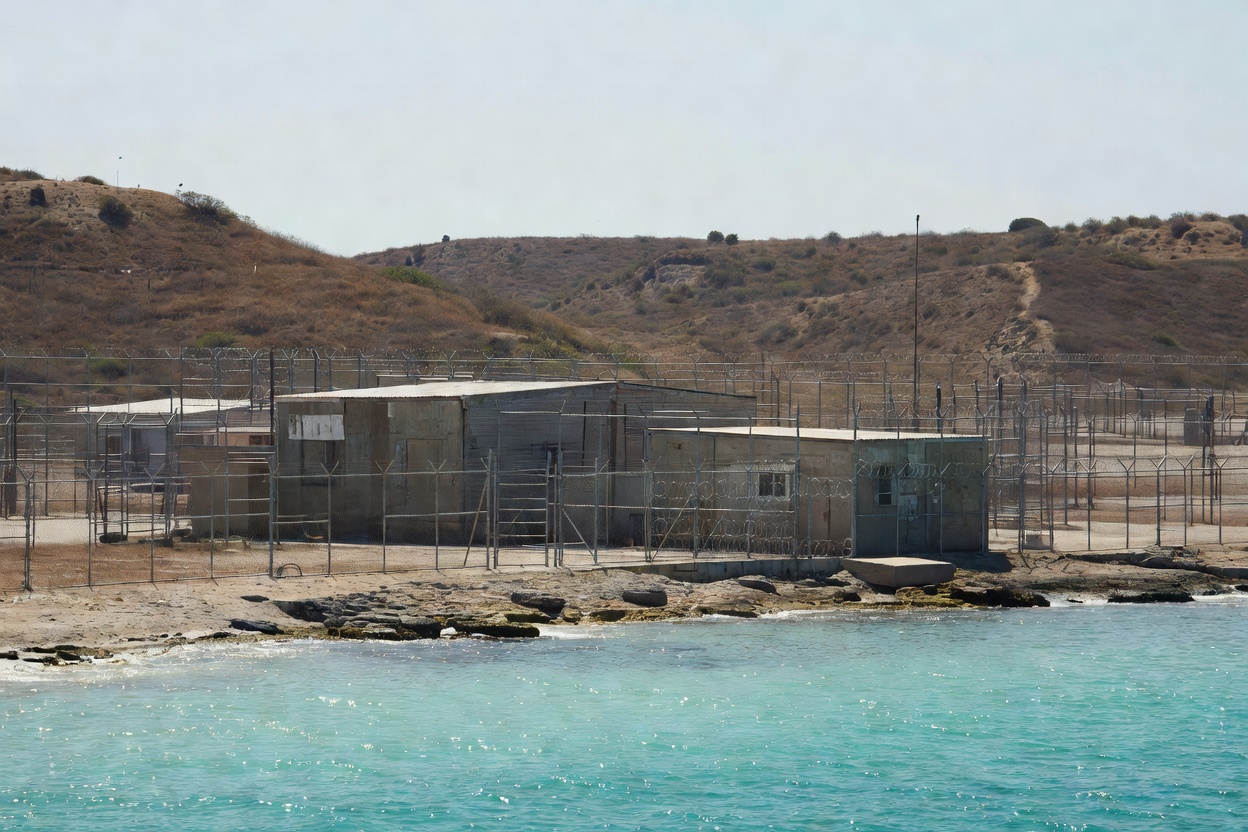
2002–today · Cuba
Guantánamo Bay detention camp
Where
US Naval Station Guantánamo Bay, Cuba (US-held) · opened 2002 · still open
Claim
Opened in January 2002 to hold men captured in the war on terrorism, outside the US mainland. About 780 men have been held there.
Why it is notorious
Detention without trial, interrogation methods and military commissions drew court challenges (Rasul 2004, Hamdan 2006, Boumediene 2008) and wide criticism. Presidents have promised to close it.
Today
Still open: 15 detainees remained as of January 2026 (La Nación, 18 Jan 2026). (checked 1 Nov 2026)
Ask
What rights should a prisoner held outside a country's borders have?
Go deeper
Lesson:APGOV.13 Incorporation and due processPreview
Illustration: Urbanicity house studio (SI-generated)
1932–today · New York City
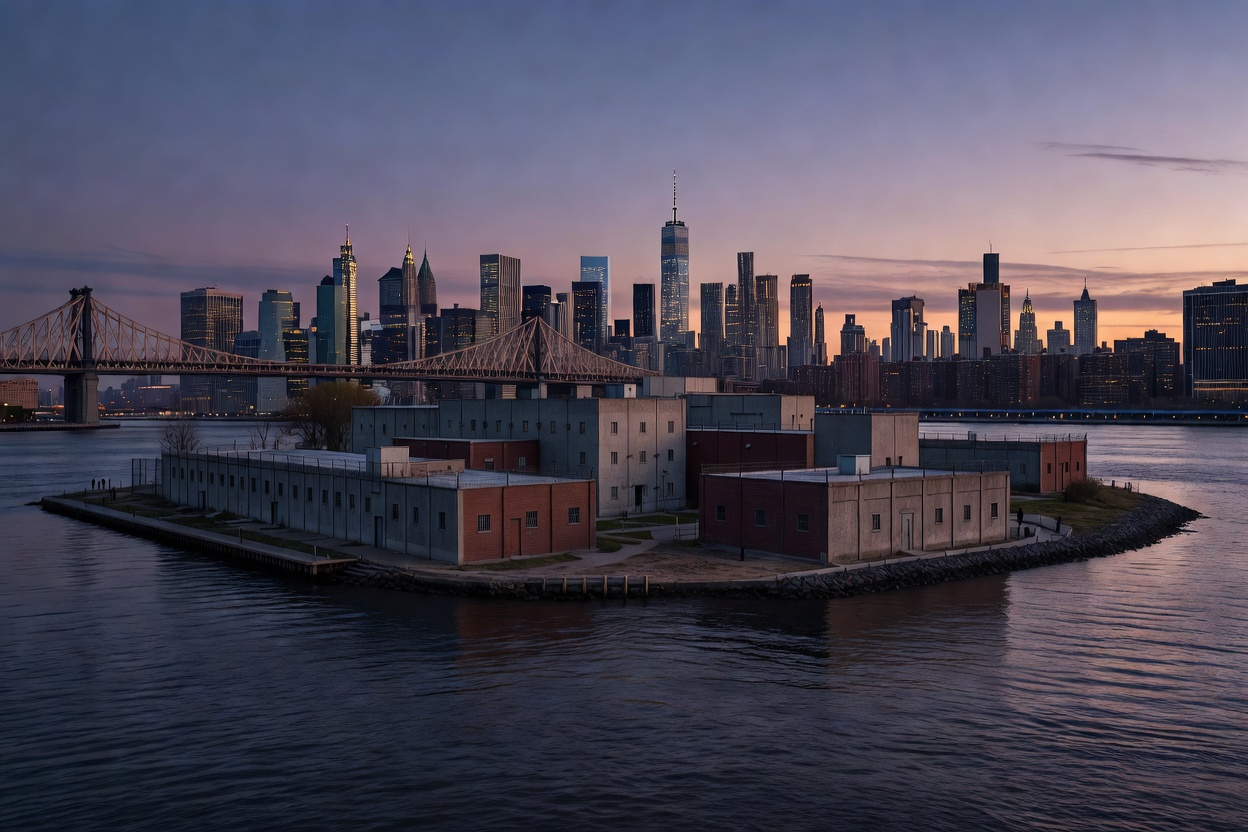
Rikers Island
Where
East River, New York City, United States · opened 1932 · closure ordered by 2027
Claim
New York City's main jail complex, on an island in the East River, holding mostly people awaiting trial.
Why it is notorious
Violence, deaths in custody and long waits for trial led the city to vote in 2019 to close it and replace it with smaller borough jails, under federal court oversight.
Today
Still open. City law requires closure by 31 August 2027; reports say the city will not meet it (Amsterdam News, 27 Aug 2026). (checked 1 Nov 2026)
Ask
Most people at Rikers have not been convicted. What should a jail for the unconvicted look like?
The map · server-rendered from our Postgres tables
Who punishes most: a tile map of the states
Each square is a state. The top number is how many facilities our prison table lists there; the bottom number is how many people were in that state's prisons at the end of 2023 (BJS). Color shows one of three layers: pick it below. Hover or tap a square for details.
AK
0 fac
4k
ME
0 fac
2k
VT
0 fac
1k
NH
1 fac
2k
WA
3 fac
14k
ID
0 fac
10k
MT
1 fac
5k
ND
0 fac
2k
MN
4 fac
9k
IL
9 fac
30k
WI
1 fac
22k
MI
1 fac
33k
NY
8 fac
33k
RI
0 fac
3k
MA
1 fac
6k
OR
2 fac
12k
NV
1 fac
10k
WY
0 fac
2k
SD
2 fac
4k
IA
0 fac
9k
IN
3 fac
25k
OH
2 fac
47k
PA
9 fac
39k
NJ
2 fac
12k
CT
2 fac
11k
CA
14 fac
96k
UT
1 fac
6k
CO
5 fac
17k
NE
1 fac
6k
MO
1 fac
24k
KY
5 fac
19k
WV
6 fac
6k
VA
3 fac
27k
MD
1 fac
16k
DE
0 fac
5k
AZ
4 fac
34k
NM
1 fac
6k
KS
3 fac
9k
AR
1 fac
19k
TN
2 fac
24k
NC
2 fac
31k
SC
4 fac
16k
DC
0 fac
—
OK
2 fac
22k
LA
4 fac
28k
MS
2 fac
20k
AL
4 fac
27k
GA
4 fac
50k
HI
1 fac
4k
TX
16 fac
149k
FL
7 fac
87k
State
Facilities (our table)
…with death row flag
Prisoners, 2023
Death row, 2023
Executions 1977–2023
Status today
Alabama
4
1
27,181
158
72
Death penalty
Alaska
0
0
4,478
0
0
No death penalty (1957)
Arizona
4
0
34,473
111
40
Death penalty
Arkansas
1
0
18,503
27
31
Death penalty
California
14
1
95,962
653
13
Death penalty (executive hold)
Colorado
5
0
17,459
0
1
No death penalty (2020)
Connecticut
2
0
11,099
0
1
No death penalty (2012)
Delaware
0
0
4,867
0
16
No death penalty (2016)
District of Columbia
0
0
—
—
—
Abolished
Florida
7
1
87,207
287
105
Death penalty
Georgia
4
1
50,425
37
76
Death penalty
Hawaii
1
0
3,942
0
0
No death penalty (1957)
Idaho
0
0
9,829
8
3
Death penalty
Illinois
9
0
29,828
0
12
No death penalty (2011)
Indiana
3
1
25,088
8
20
Death penalty
Iowa
0
0
8,831
0
0
No death penalty (1965)
Kansas
3
0
9,125
9
0
Death penalty
Kentucky
5
0
19,175
26
3
Death penalty
Louisiana
4
1
28,186
60
28
Death penalty
Maine
0
0
1,873
0
0
No death penalty (1887)
Maryland
1
0
16,236
0
5
No death penalty (2013)
Massachusetts
1
0
6,002
0
0
No death penalty (1984)
Michigan
1
0
32,986
0
0
No death penalty (1847)
Minnesota
4
0
8,725
0
0
No death penalty (1911)
Mississippi
2
1
19,526
36
23
Death penalty
Missouri
1
0
24,223
12
97
Death penalty
Montana
1
1
4,985
2
3
Death penalty
Nebraska
1
1
5,931
11
4
Death penalty
Nevada
1
1
10,463
52
12
Death penalty
New Hampshire
1
0
2,115
1
0
No death penalty (2019)
New Jersey
2
0
11,675
0
0
No death penalty (2007)
New Mexico
1
0
5,586
0
1
No death penalty (2009)
New York
8
0
32,583
0
0
No death penalty (2007)
North Carolina
2
1
30,685
136
43
Death penalty
North Dakota
0
0
1,899
0
0
No death penalty (1973)
Ohio
2
1
46,530
120
56
Death penalty (executive hold)
Oklahoma
2
0
22,283
36
123
Death penalty
Oregon
2
1
12,316
0
2
Death penalty (executive hold)
Pennsylvania
9
0
38,860
96
3
Death penalty (executive hold)
Rhode Island
0
0
2,519
0
0
No death penalty (1984)
South Carolina
4
0
16,453
32
43
Death penalty
South Dakota
2
0
3,764
1
5
Death penalty
Tennessee
2
0
24,408
45
13
Death penalty
Texas
16
2
149,264
180
586
Death penalty
Utah
1
1
6,402
7
7
Death penalty
Vermont
0
0
1,334
0
0
No death penalty (1972)
Virginia
3
0
27,442
0
113
No death penalty (2021)
Washington
3
0
14,441
0
5
No death penalty (2023)
West Virginia
6
0
5,800
0
0
No death penalty (1965)
Wisconsin
1
0
22,418
0
0
No death penalty (1853)
Wyoming
0
0
2,212
0
1
Death penalty
Federal (BOP)
—
—
156,627
41
16
Death penalty retained
What the data can and cannot say. Our own prison table (emergency.prisons) lists 169 facilities, mostly federal prisons plus a sample of state, county, private and historic sites, with 16 flagged as holding a death row. It is a partial list, not a census: a state with "1 fac" may have dozens of prisons. The table has no prisoner counts, so the prisoner numbers, death-row counts and executions come from the Bureau of Justice Statistics (2023 tables) and the status layer from the Death Penalty Information Center. These published figures are kept in research.penology_state_stats, labeled by source. Federal prisoners and the federal death row are counted separately, not in any state.
The theorists
Six ways to read the gallery
Open a theorist's card for a short life, the idea, the works in the prison bibliography below, and where each room of the gallery uses them.
CB
Theorist card · punishment
Cesare Beccaria
1738–1794
Punish to prevent, not to avenge; certainty beats severity.
Life
A young Milanese nobleman and economist, Beccaria wrote On Crimes and Punishments at 26, out of the talk of a reform circle led by the brothers Pietro and Alessandro Verri. It was published anonymously in 1764, read across Europe and America within a few years, and later he taught public economy in Milan.
The idea
Punishment is justified only to prevent future harm. Laws should be public and clear, trials fair and prompt, and penalties proportionate to the harm done. A certain, swift punishment deters more than a cruel one. He condemned torture outright and argued that the death penalty is neither necessary nor useful.
CR1.29 The penitentiary ideaPreview · APEURO.5 The Enlightenment benchPreview
Full theory card: in preparation.
JB
Theorist card · punishment
Jeremy Bentham
1748–1832
Pleasure and pain are the levers; design the building so people govern themselves.
Life
The English philosopher who founded utilitarianism: judge every law by whether it produces "the greatest happiness of the greatest number." With his brother Samuel, who had devised an inspection building in Russia, he drew the panopticon and spent years and much of his fortune trying to have Britain build it. Parliament chose another plan, and Millbank prison rose on the land instead.
The idea
People weigh pleasure against pain, so the law should set pains just large enough to outweigh the gain of a crime, and no larger. The panopticon applies the idea to a building: a hidden inspector who may always be watching makes prisoners watch themselves, cheaply and without the lash.
CR1.29 The penitentiary ideaPreview · SO1.15 Deviance and social controlPreview
Full theory card: in preparation.
Theorist card · punishment
Émile Durkheim
1858–1917
Punishment shows the group what it holds sacred and draws its boundary.
Life
The French scholar who made sociology a university discipline, first at Bordeaux and then at the Sorbonne. His books on the division of labor, method, suicide and religion set out how a society holds together.
The idea
Crime is normal: every society has it, even "a society of saints." Punishment matters less for the criminal than for the law-abiding: it expresses their shared outrage and so renews the "collective conscience." As societies grow complex, punishment shifts from repressive law that avenges to restitutive law that repairs.
Power moved from the scaffold to the timetable, the file and the watched cell.
Life
A French philosopher and historian of ideas who held a chair at the Collège de France. In 1971 he helped found a group that gathered prisoners' own accounts of prison life, and Discipline and Punish followed in 1975.
The idea
Punishment changed its target. The public torture of the body gave way to a quieter power that trains the soul: the timetable, the drill, the examination, the file and the watched cell. The panopticon is his image for a "disciplinary society" whose methods spread to schools, barracks, hospitals and factories.
Late-modern insecurity turned crime policy from rehabilitation to risk and exclusion.
Life
A Scottish-born sociologist of punishment, trained at Edinburgh, who teaches law and sociology at New York University. He wrote the standard synthesis of punishment theory, an account of the punitive turn, and a study of the American death penalty, Peculiar Institution (2010).
The idea
Punishment is a social institution, not only a tool against crime: it carries moral feeling (Durkheim), economic interest (Marx), power (Foucault) and culture (Elias) at once. After the 1970s, high crime, insecurity and politics moved the United States and Britain from rehabilitation toward risk management, victims' rights and long sentences: "the culture of control."
CR1.31 "Nothing works" and long sentencesPreview · CR1.32 Mass incarcerationPreview
Full theory card: in preparation.
MA
Theorist card · punishment
Michelle Alexander
b. 1967
Mass incarceration works as a racial caste system through the label of "felon."
Life
A civil rights lawyer and legal scholar. She led the Racial Justice Project of the ACLU of Northern California, taught law at Ohio State, and later wrote opinion columns for The New York Times. The New Jim Crow (2010) became one of the most read books on American punishment.
The idea
The war on drugs and mass incarceration function as a racial caste system. Arrest and conviction fall unevenly by race, and the label "felon" then permits legal discrimination in voting, jobs, housing and benefits long after a sentence ends. Critics answer that violent crime and local politics drive more of the prison rise than drug law; read her beside the National Research Council report.
CR1.32 Mass incarcerationPreview · CR1.35 Capstone: the case filePreview
Full theory card: in preparation.
Punishment and deviance · sociology, criminology, social theory, social history
Before the punishment: the deviant
Every room in this gallery answers a second question underneath the first: who decided this person had broken the rules, and why did the group need to show it? Sociology calls that question deviance. Read the gallery through these four questions; each thinker links to a theory card, and most link to a lesson where students work with the idea.
Durkheim says punishment is really for the people who obey. Pick one room and explain who the audience was.
Becker says the rule-makers create deviance. Who made the rules behind the press gang, convict leasing or the "felon" label, and who was caught by them?
Elias and Foucault both see punishment moving out of sight. Is a hidden punishment gentler, or only harder to question?
Linebaugh asks whose property the gallows protected. Ask the same of a modern sentence you read about this week.
Books cited on each card are named there and listed, with notes, in the prison bibliography below.
Prison bibliography · annotated for the museum
Prisons and punishment: the books behind the gallery
41 works from the estate bibliography, each with a short note and where the gallery uses it.
Michelle Alexander, The New Jim Crow: Mass Incarceration in the Age of Colorblindness (New York: The New Press, 2010).
Alexander argues that the war on drugs and mass incarceration function as a racial caste system: the label "felon" permits legal discrimination in voting, jobs and housing long after a sentence ends. The book shaped the reform debate of the 2010s and drew critics who stress violent crime and local politics.In the gallery: Room 4 mass incarceration card; deviance table (records and risk scores); theorist modal.
Robert Bartlett, Trial by Fire and Water: The Medieval Judicial Ordeal (Oxford: Clarendon Press, 1986).
How the ordeal worked, why people trusted it, and why it ended after the Fourth Lateran Council of 1215.In the gallery: Room 1 ordeal card.
J. M. Beattie, Crime and the Courts in England, 1660-1800 (Princeton: Princeton University Press, 1986).
How English courts actually punished: the pillory, branding, whipping, transportation and the gallows, and the move toward imprisonment.In the gallery: Room 1 stocks, pillory, brand and lash card.
Cesare Beccaria, On Crimes and Punishments (Livorno: Coltellini (Eng. ed. R. Bellamy, Cambridge University Press, 1995), 1764).
The founding text of modern criminal-law reform. Beccaria argues that punishment is justified only to prevent crime, that it should be public, prompt and proportionate, and that certainty deters more than severity. He condemns torture and the death penalty.In the gallery: Room 2, Beccaria card; theorist modal; the "find a modern law he would criticize" exercise.
Howard S. Becker, Outsiders: Studies in the Sociology of Deviance (New York: Free Press, 1963).
Labeling theory's classic: deviance is not a quality of the act but of the reaction to it, and rule-makers ("moral entrepreneurs") create deviance by making the rules.In the gallery: Deviance table, labeling; SO1.15 lesson.
Jeremy Bentham, Panopticon; or, The Inspection-House (London: T. Payne, 1791).
Bentham's letters proposing a circular prison where a hidden inspector can see every cell, so that prisoners come to govern themselves. The plan was never built as drawn, but it became the reference point for prison architecture and, through Foucault, for theories of surveillance.In the gallery: Room 2, panopticon card and floor plan; Room 6 ankle monitor ("the tower, worn on the leg").
Douglas A. Blackmon, Slavery by Another Name: The Re-Enslavement of Black Americans from the Civil War to World War II (New York: Doubleday, 2008).
A Pulitzer Prize history of convict leasing: vagrancy laws and fee-driven courts fed Black men into mines, farms and camps across the South until the 1940s.In the gallery: Room 3 convict leasing card.
W. E. B. Du Bois, Black Reconstruction in America, 1860-1880 (New York: Harcourt, Brace, 1935).
Du Bois's history of Reconstruction and its overthrow, including how vagrancy laws and convict leasing rebuilt forced labor after emancipation.In the gallery: Room 3 convict leasing; deviance section, social history.
W. Jeffrey Bolster, Black Jacks: African American Seamen in the Age of Sail (Cambridge, MA: Harvard University Press, 1997).
Black sailors in the Atlantic world, the freedom and danger of the sea, and the threat of impressment and sale.In the gallery: Room 1 impressment card; deviance section, social history.
Denver Brunsman, The Evil Necessity: British Naval Impressment in the Eighteenth-Century Atlantic World (Charlottesville: University of Virginia Press, 2013).
The fullest account of the press gang: how impressment worked, how many men it took, and how coastal communities resisted it.In the gallery: Room 1 impressment card, main source.
Robert E. Burns, I Am a Fugitive from a Georgia Chain Gang! (New York: Vanguard Press, 1932).
A memoir of escape from a Georgia chain gang; with the film made from it, it drew national outrage at the system.In the gallery: Room 3 chain gang card.
Charles Dickens, American Notes for General Circulation (London: Chapman and Hall, 1842).
Dickens's American travels; chapter 7 describes Eastern State Penitentiary and argues that long solitary confinement damages the mind more than the lash.In the gallery: Room 2 Two American systems; Room 4 supermax comparison.
Émile Durkheim, The Rules of Sociological Method (Free Press, New York, 1982).
First published 1895. Discipline: Sociology.In the gallery: Deviance table: crime is normal, the "society of saints"; theorist modal (Durkheim).
Émile Durkheim, The Division of Labor in Society (Free Press, New York, 1984).
First published 1893. Discipline: Sociology.In the gallery: Room 1 outlawry and exile; deviance table (punishment and the collective conscience); theorist modal (Durkheim).
National Research Council (J. Travis, B. Western, S. Redburn, eds.), The Growth of Incarceration in the United States: Exploring Causes and Consequences (Washington, DC: National Academies Press, 2014). doi:10.17226/18613.
The authoritative review of why US imprisonment rose fivefold after 1972, finding that policy choices, not crime alone, drove it, and weighing its effects on crime, families and communities.In the gallery: Room 4 mass incarceration card, chief evidence; free from the National Academies.
A. Roger Ekirch, Bound for America: The Transportation of British Convicts to the Colonies, 1718-1775 (Oxford: Clarendon Press, 1987).
The earlier transportation to Maryland and Virginia, ended by the American Revolution: who was sent, how they were sold and what became of them.In the gallery: Room 1 transportation card (Maryland and Virginia).
Norbert Elias, The Civilizing Process (Basel: Haus zum Falken (Eng. ed. Oxford: Blackwell, 1969 and 1982), 1939).
Manners and self-restraint tightened over centuries in Europe, and violence and cruelty were pushed out of public sight. Used to explain why punishment moved behind walls.In the gallery: Deviance table: why punishment moved out of sight; Room 1 scaffold card.
Virginia Eubanks, Automating Inequality: How High-Tech Tools Profile, Police, and Punish the Poor (New York: St. Martin's Press, 2018).
Algorithms and databases in welfare, housing and child protection as a "digital poorhouse" that watches and sorts the poor.In the gallery: Deviance section: records, risk scores, the "digital poorhouse"; Room 6 ankle monitor.
Michel Foucault, Discipline and Punish: The Birth of the Prison (New York: Pantheon (trans. Alan Sheridan; French ed. 1975), 1977).
Foucault traces the shift from punishing the body in public to training the soul in private: the timetable, the examination, the file and the watched cell. The panopticon becomes his model for a disciplinary society that reaches into schools, barracks and factories.In the gallery: Room 1 scaffold card (the 1757/1838 opening); Room 2 panopticon; deviance table; theorist modal.
David Garland, Punishment and Modern Society: A Study in Social Theory (Chicago: University of Chicago Press, 1990).
A synthesis of Durkheim, Marx, Foucault and Elias on what punishment does beyond controlling crime. Garland reads penal practice as a social institution carrying moral feeling, economic interest, power and culture at once.In the gallery: Theorist modal (Garland); frames the whole gallery as a social institution.
David Garland, The Culture of Control: Crime and Social Order in Contemporary Society (Chicago: University of Chicago Press, 2001).
Garland explains how the United States and Britain turned from rehabilitation after the 1970s toward risk management, victims' rights and exclusion. Rising crime, insecurity and politics, not crime alone, built the new penal state.In the gallery: Room 4 mass incarceration card; deviance table; theorist modal.
V. A. C. Gatrell, The Hanging Tree: Execution and the English People, 1770-1868 (Oxford: Oxford University Press, 1994).
The crowds at public hangings, what they felt, and why Britain ended public execution in 1868.In the gallery: Room 1 scaffold as theater card.
Paul A. Gilje, Free Trade and Sailors' Rights in the War of 1812 (Cambridge: Cambridge University Press, 2013).
How impressment and the seizure of American sailors became a cause and a slogan of the War of 1812.In the gallery: Room 1 impressment card (Chesapeake-Leopard, War of 1812).
Erving Goffman, Asylums: Essays on the Social Situation of Mental Patients and Other Inmates (New York: Anchor Books, 1961).
The "total institution": prisons, asylums, ships and barracks that strip a person of an old self and remake a new one.In the gallery: Deviance table (total institutions); Room 4 supermax.
Erving Goffman, Stigma: Notes on the Management of Spoiled Identity (Englewood Cliffs, NJ: Prentice-Hall, 1963).
How a discrediting mark, such as a criminal record, shapes every later encounter, and how people manage it.In the gallery: Deviance table; CR1.34 reentry lesson.
Robert Hughes, The Fatal Shore: The Epic of Australia's Founding (New York: Knopf, 1986).
A narrative history of the transportation of about 162,000 British convicts to Australia between 1788 and 1868 and the penal colonies they built.In the gallery: Room 1 transportation card.
Norman Johnston, Forms of Constraint: A History of Prison Architecture (Urbana: University of Illinois Press, 2000).
Prison buildings from medieval gaols to the supermax, including radial plans, Eastern State, and panopticon-inspired roundhouses at Stateville and the Presidio Modelo.In the gallery: Room 2 panopticon card (Stateville, Presidio Modelo); "See the buildings".
Alex Lichtenstein, Twice the Work of Free Labor: The Political Economy of Convict Labor in the New South (London: Verso, 1996).
How convict leasing and then the chain gang built Southern railroads, mines and highways, and why the state kept forced labor when leasing ended.In the gallery: Room 3 chain gang card.
Peter Linebaugh, The London Hanged: Crime and Civil Society in the Eighteenth Century (London: Allen Lane, 1991).
A social history of those hanged at Tyburn, showing how the "Bloody Code" defended new forms of property against workers' customary rights.In the gallery: Deviance section, social history: whose property the gallows protected.
Robert K. Merton, Social Structure and Anomie (American Sociological Review 3(5), 1938). doi:10.2307/2084686.
Strain theory: when a society praises a goal such as wealth but blocks the legitimate means, some people innovate, and some innovation is crime.In the gallery: Deviance table (strain); CR1.13 lesson.
Lisi Oliver, The Beginnings of English Law (Toronto: University of Toronto Press, 2002).
Edition and translation of the earliest English law codes, including Aethelberht's price list for injuries (wergild).In the gallery: Room 1 wergild card.
Orlando Patterson, Slavery and Social Death: A Comparative Study (Cambridge, MA: Harvard University Press, 1982).
Slavery across 66 societies defined as "social death": a person cut off from kin, honor and history. A lens for reading forced convict labor.In the gallery: Deviance section, social history; read beside convict leasing.
John Pratt, Scandinavian Exceptionalism in an Era of Penal Excess, Part I (British Journal of Criminology 48(2), 2008). doi:10.1093/bjc/azm072.
Why the Nordic countries kept low imprisonment rates and humane prisons while the United States and Britain expanded theirs: welfare states, trust and equality.In the gallery: Room 6 Nordic model (Halden) card.
Marcus Rediker, Between the Devil and the Deep Blue Sea: Merchant Seamen, Pirates, and the Anglo-American Maritime World, 1700-1750 (Cambridge: Cambridge University Press, 1987).
The ship as a floating workhouse of wages, discipline and the lash, and the pirate crew as a rebellion against it.In the gallery: Room 1 impressment card; deviance section, social history; ties to the Museum of Atlantic Piracy.
Lorna A. Rhodes, Total Confinement: Madness and Reason in the Maximum Security Prison (Berkeley: University of California Press, 2004).
An ethnography of supermax prisons in Washington State: isolation, mental illness and the staff who run the units.In the gallery: Room 4 supermax and solitary card.
David J. Rothman, The Discovery of the Asylum: Social Order and Disorder in the New Republic (Boston: Little, Brown, 1971).
Why Jacksonian Americans built penitentiaries, asylums and almshouses: reformers feared a disordered society and hoped institutions would remake the deviant. The standard account of Eastern State and Auburn.In the gallery: Room 2, Two American systems card (Eastern State vs Auburn).
David J. Rothman, Conscience and Convenience: The Asylum and Its Alternatives in Progressive America (Boston: Little, Brown, 1980).
The Progressive reforms of probation, parole, the indeterminate sentence and the juvenile court, and how good intentions bent to administrative convenience in practice.In the gallery: Room 2 reformatory and juvenile court card; Room 6 probation and parole.
Peter Conrad and Joseph W. Schneider, Deviance and Medicalization: From Badness to Sickness (St. Louis: C. V. Mosby, 1980).
How behavior once punished (drinking, madness, hyperactivity) came to be treated as illness, shifting control from judges to doctors.In the gallery: Deviance table; Room 6 drug courts.
Edwin H. Sutherland, White Collar Crime (New York: Dryden Press, 1949).
Crime is learned in groups like any skill, and the respectable classes commit it too: the book that named white-collar crime.In the gallery: Deviance table; CR1.14 lesson.
Frank Tannenbaum, Crime and the Community (Boston: Ginn and Company, 1938).
Introduces "the dramatization of evil": tagging a young person as a criminal helps make him one. A forerunner of labeling theory.In the gallery: Deviance table, labeling ("the dramatization of evil").
Howard Zehr, Changing Lenses: A New Focus for Crime and Justice (Scottdale, PA: Herald Press, 1990).
The founding statement of restorative justice: crime as harm to people and relationships, and justice as repair agreed among victim, offender and community.In the gallery: Room 6 restorative justice card.